In the twelfth century, several thousand people cut a city into the side of a cliff above the Mtkvari river. Not a cave complex that grew — a planned settlement, thirteen storeys of it, with a bakery, a library, wine cellars, a water system that still runs, and a church holding one of the only portraits of Queen Tamar painted while she was alive. Then, in 1283, an earthquake took the front of the mountain off and exposed rooms that were never meant to be seen from outside.
That is Vardzia, and it is the middle of this tour rather than the whole of it.
The four days run south from Tbilisi into Samtskhe-Javakheti, which does not look or sound like the rest of the country. The plateau sits above 2,000 metres — volcanic, treeless, cold at night in July — and its villages are mostly Armenian, so you cross a language border without crossing a national one. Paravani, Georgia’s largest lake, fills a crater up there and rarely gets above 15 °C. On its shore is a working nunnery whose sisters make cheese and chocolate, which is not what you expect at the end of a road like that.
Day two is the cliffs: Khertvisi on its rock where two rivers meet, Vardzia itself, the hermit caves at Vanis Kvabebi where the difficulty of the approach was the point, and a jeep track up to the ruins at Upper Tmogvi that ordinary cars cannot manage — which is why you will probably have it to yourselves. Then a family table in Saro, where the wine comes out of buried qvevri and the grapes are varieties that only make sense at this altitude in this soil.
Day three swaps rock for forest. Rabati at Akhaltsikhe holds a church, a mosque, a synagogue and an Armenian church inside one wall, which tells you more about this region than any label could. Sapara, twenty minutes up a forest road, has frescoes from the 1300s that nobody has restored into blandness. And then Borjomi — mineral water straight from the spring in the park, warm and salty and strange — and two or three hours on horseback into a national park of 85,000 hectares where there are still bears.
The last morning goes up to Abastumani, where an observatory has been reading the sky from 1,650 metres since 1932, before the drive back to Tbilisi. Caves cut into the earth on Tuesday, a telescope pointed away from it on Friday. That symmetry is not accidental; it is the reason the tour is shaped this way.
It runs from Tbilisi as standard. If you are flying into or out of Kutaisi, we can start there, finish there, or both — say so when you book and we will build it round your flights.
What you’ll see
Tour highlights
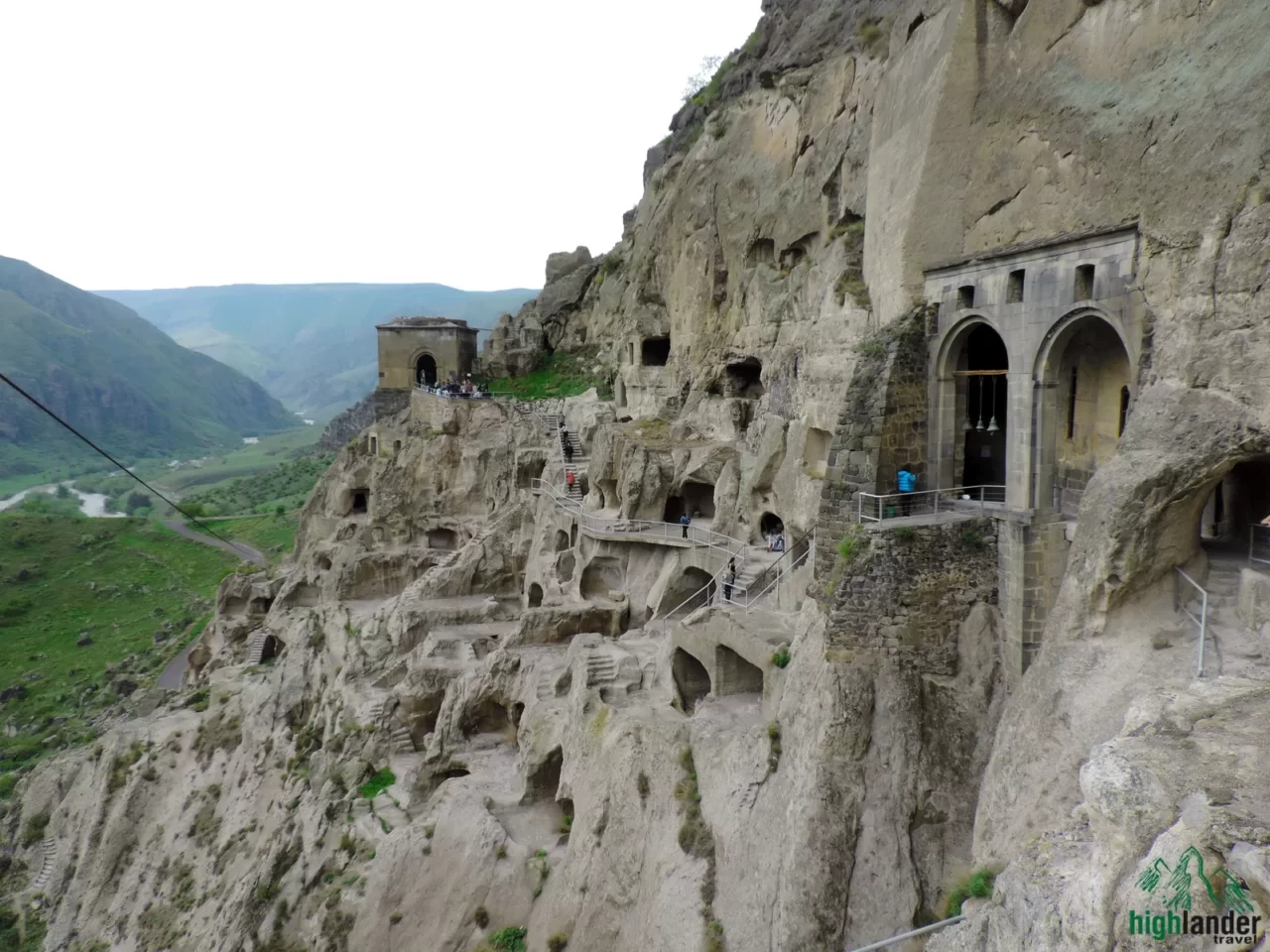
- Vardzia. A twelfth-century city cut into a cliff — around 6,000 chambers originally, roughly 500 surviving the 1283 earthquake that stripped the mountain’s outer face away. Bakery, library, wine cellars, defensive tunnels, a working water system, and a fresco of Queen Tamar painted in her lifetime.
- Vanis Kvabebi and Upper Tmogvi. Hermit cells on a vertical face downstream from Vardzia, where the hard approach was the spiritual point. Then a jeep track to a ruined fortress village that ordinary vehicles cannot reach, and usually nobody else on it.
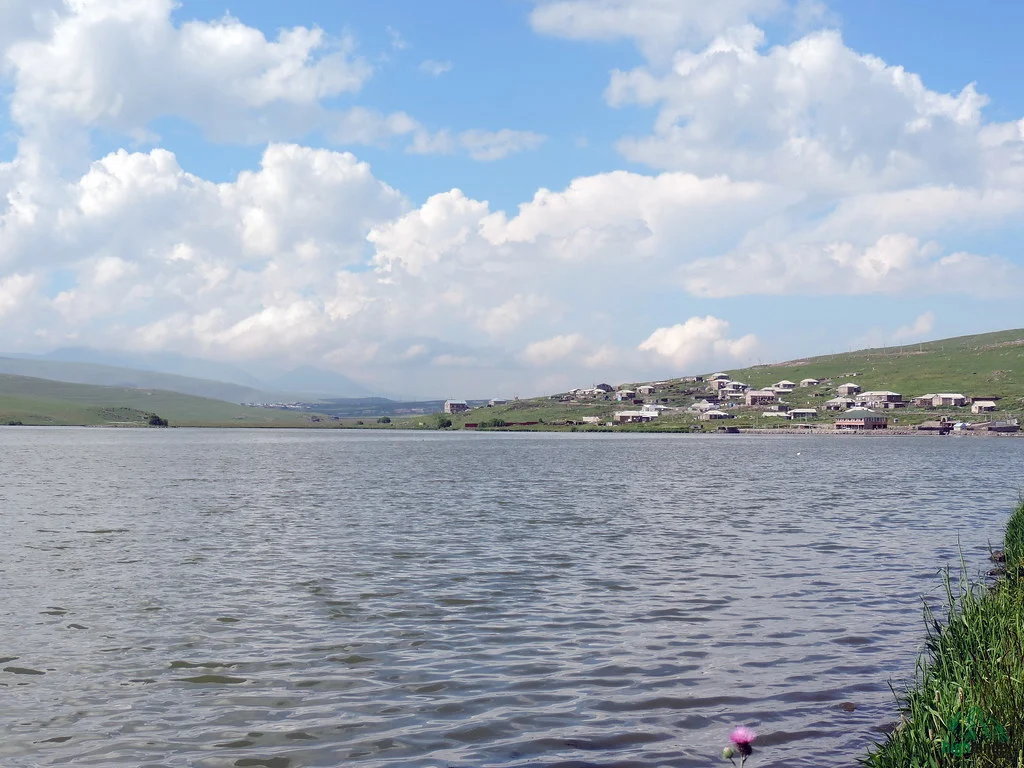
- Paravani Lake and the Javakheti plateau. Georgia’s largest lake, 37 square kilometres in a volcanic crater at 2,073 metres, cold enough to keep swimmers out in August. Treeless highland, basalt, and villages where the everyday language is Armenian.
- Poka nunnery. On the lake shore, at the end of a road that does not go anywhere else. The sisters make cheese and chocolate and sell them at the gate.
- Khertvisi and Rabati. A tenth-century fortress on the rock where the Paravani meets the Mtkvari, and at Akhaltsikhe a citadel that contains an Orthodox church, an Armenian church, a mosque and a synagogue inside one set of walls.
- Sapara Monastery. Twenty minutes up a forest road from Akhaltsikhe, with wall paintings from the thirteenth and fourteenth centuries that have not been restored into blandness.
- Saro village. Lunch and wine at a family table, from qvevri buried in the yard, made from grape varieties suited to volcanic soil at altitude. Not wine you will find in a Tbilisi shop.
- Borjomi and horseback in the national park. Mineral water warm from the spring in the park, then two to three hours riding into Borjomi-Kharagauli — 85,000 hectares of forest that still holds bears, wolves and lynx. Beginners welcome; the pace is a walk.
- Abastumani Observatory. Founded in 1932 at 1,650 metres for the clarity of its sky, and still working. Weather and their schedule permitting.
- Dashbashi Canyon. Basalt walls to about 100 metres, waterfalls, and a glass bridge suspended over the gorge on the way south from Tbilisi.
Step by step
Tour itinerary
Day 1 · Tbilisi to the Javakheti plateau
Tbilisi → Dashbashi Canyon → Javakheti plateau → Paravani Lake → Poka → Sagamo. About 250 km. A long day — expect to reach the guesthouse in the evening.
The road south out of Tbilisi is ordinary for the first hour and then stops being. At Dashbashi the Khrami river has cut a gorge through old lava flows, leaving basalt walls up to a hundred metres and a string of waterfalls along the floor. A glass bridge now hangs across it, which is either the best or the worst thing that has happened to the canyon depending on who you ask; either way you can stand out over the middle of it and look straight down.
After that the road climbs, and keeps climbing. Somewhere above 1,800 metres the trees give up. The Javakheti plateau is volcanic tableland — grass, black rock, enormous sky, and villages of low stone houses where the shop signs are in Armenian. It is cooler and drier than anywhere you have been in Georgia so far, and in July the difference between midday and nine in the evening is about fifteen degrees.
Paravani is up here at 2,073 metres: Georgia’s largest lake, thirty-seven square kilometres of crater filled with water that seldom passes 15 °C. On a still day the peaks around it come back off the surface. On a windy one — and it is often windy — it looks like slate.
At the village of Poka, on the shore, there is a working nunnery. The sisters run a dairy and a small chocolate workshop and sell both at the gate; buy some. Then Sagamo, a second crater lake, smaller and emptier, for the last of the light.
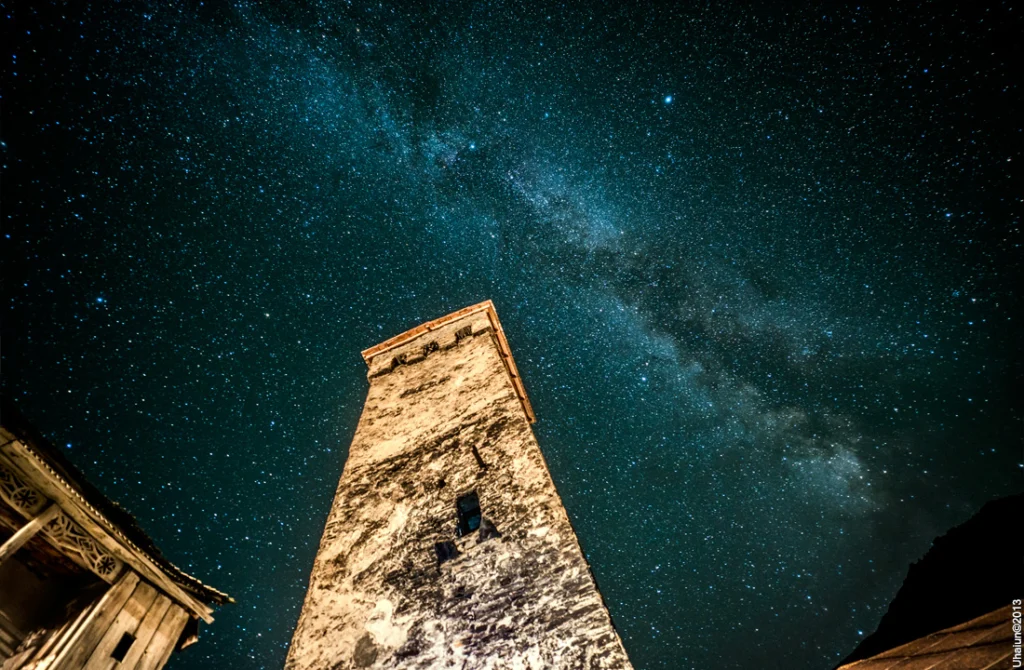
Up here there is almost no light pollution and the air is thin. If the sky is clear, go outside after dinner.
Overnight: guesthouse on the Javakheti plateau. Lunch and dinner included.
Day 2 · Vardzia, the hermit caves and Saro
Javakheti → Khertvisi → Vardzia → Vanis Kvabebi → Upper Tmogvi by jeep → Saro. A full day, and the most walking of the four.
The morning follows the Mtkvari down through a gorge that gets narrower and stranger as you go. By high summer the slopes here are the colour of dust — eroded volcanic rock, almost no vegetation, shapes that do not look like they were made by weather.
Khertvisi comes first, a tenth-century fortress on an outcrop at the junction of the Paravani and the Mtkvari. Everyone who wanted this valley fought for this rock — Georgians, Mongols, Ottomans — and each of them added to the walls. Standing on them, you can see the whole argument at once.
Then Vardzia. Around six thousand chambers were cut into this cliff during the reign of Queen Tamar; the earthquake of 1283 took the outer face of the mountain off, and roughly five hundred caves survive, in tiers that in places run thirteen and more deep. What is left is a cross-section of a building that was never meant to be seen from outside. You walk corridors carved in solid rock, up stairs worn smooth in the middle, past bakery and cellars and living quarters, into a church whose walls carry a portrait of Tamar painted while she was still alive — one of very few. The spring that supplied the complex still runs. Give this two hours; it repays the second one.
A short way downstream, Vanis Kvabebi clings to a vertical face. These were hermit cells, reached by narrow paths, and the difficulty was deliberate: the monks who came here wanted a life that cost something to get to.
In the afternoon a 4×4 with a local driver takes the group up a track no ordinary car will manage, to the ruins of Upper Tmogvi on a ridge above the gorge. Few people make the effort. You will most likely have the whole ridge to yourselves, which is worth the shaking you take on the way up.
The day ends at a family table in Saro, a wine village that tourism has not found. The volcanic soil and the altitude give the grapes here a character you will not meet in Kakheti, the fermentation happens in qvevri buried in the yard, and the food comes out of the garden behind the house. Expect more of it than you can eat and a run of toasts you will not entirely follow.
Overnight: Akhaltsikhe (or near Vardzia on request). Breakfast, lunch and dinner included.
Day 3 · Rabati, Sapara and a forest on horseback
Akhaltsikhe → Rabati fortress → Sapara Monastery → Borjomi → horse riding in Borjomi-Kharagauli National Park. A full day.
Akhaltsikhe means “new castle”, which stopped being accurate several centuries ago. The Rabati complex above the town holds a Georgian Orthodox church, an Armenian church, a mosque with its minaret, and a synagogue, all inside one set of walls — four communities that lived here at the same time, arranged the way they actually were. The Ottomans held the town for a long stretch and the architecture says so.
The 2012 restoration was thorough, and not everyone approves; some preservationists think it went too far and left a replica where a ruin had been. Judge it yourself. As a way of understanding what this border region was, it works.
Twenty minutes east, up a road that winds into thick forest, Sapara Monastery is the opposite case. Nobody has smoothed it over. The main church holds frescoes from the thirteenth and fourteenth centuries — confident composition, colour that has held for six hundred years, Orthodox iconography worked through in a distinctly Georgian way. Where Vardzia dominates its cliff, Sapara sits down into the hillside and almost disappears.
North from there the landscape changes again, from the dry south into humid mountain forest, and drops into the gorge where Borjomi sits at 810 metres. In the central park a spring delivers the mineral water warm — carbonated, salty, faintly metallic, and not at all like the bottle. Georgians queue at it with five-litre containers. Try a cup; you will either love it or make a face, and both are the correct response.
The afternoon goes into Borjomi-Kharagauli National Park, 85,000 hectares of temperate forest with bears, wolves, lynx and more than two hundred bird species in it. You ride into it for two to three hours on trail horses that have done this many times. No experience needed — the guides match riders to animals, the pace is a walk with some trot if you want it, and after twenty minutes you stop thinking about the horse and start noticing how big the forest is.
Overnight: Borjomi. Breakfast, lunch and dinner included.
Day 4 · Abastumani, and back to Tbilisi
Borjomi → Abastumani Observatory → Tbilisi. About 160 km on the return leg, 3–4 hours. Half a day plus the transfer.
Twenty kilometres from Borjomi, at 1,650 metres, sits the Abastumani Astrophysical Observatory. It was founded in 1932 — the site chosen for the number of clear nights, the stillness of the air and the height — and it has been reading the sky ever since, through the Soviet period and out the other side. It is a working institute, and the visit depends on their schedule and the weather, but when it happens you see the historic telescopes and hear from people who use them what a mountain does for an image.
It is a deliberate ending. On Tuesday you went inside a mountain because monks wanted to be closer to something they could not see. On Friday you look through a lens pointed at the same problem from the other direction. Eight hundred years apart, roughly forty kilometres apart, and not really a different question.
If the weather does not cooperate, the morning goes back into Borjomi — a longer walk in the park, the sulphur pools, or the town itself, which is worth an unhurried hour.
Then the drive to Tbilisi: about 160 kilometres, three to four hours depending on the road at Gori. It is a good stretch for working out what you actually saw.
Ends: Tbilisi. Kutaisi start and/or finish available — ask when booking. Breakfast included; lunch depending on timing.
Starting from
—
per person
Locally operated since 2011
We reply within 24 hours
What your price covers
What’s included
Included
- Licensed English-speaking driver-guide for all four days (Russian or German on request, subject to availability)
- Private vehicle throughout, plus a 4×4 with a local driver for the Upper Tmogvi track
- Three nights’ accommodation with private bathrooms — one guesthouse on the Javakheti plateau, one in Akhaltsikhe or near Vardzia, one hotel in Borjomi
- Ten meals: three breakfasts, four lunches, three dinners
- Wine tasting and lunch at a family house in Saro village
- Two to three hours of horse riding in Borjomi-Kharagauli National Park, guide and equipment included
- All entrance fees — Dashbashi Canyon and the glass bridge, Vardzia, Rabati, Sapara, national park entry
- Abastumani Observatory visit, weather and observatory schedule permitting
- Mineral water tasting at the springs in Borjomi Central Park
- Fuel, parking, road tolls and all driver expenses
Not included
- International flights and any travel to or from the start point (Tbilisi, or Kutaisi if arranged)
- Travel insurance — we strongly recommend it, and it should cover horse riding
- Two meals not listed above, depending on the day’s timing
- Alcohol beyond the wine included at the Saro tasting
- Personal spending and souvenirs
- Anything optional that is not in the itinerary
- Tips for the guide and driver — never expected, always welcome
Photographs
Gallery
Where you’ll go
Map & route
Practical details
Good to know before you go
The essentials
- Length: 4 days, 3 nights
- Starts and ends: Tbilisi. Kutaisi start, Kutaisi finish, or both, on request
- Distance: around 750 km over four days
- Group: private — your party only. Works for 2 to 10 people
- Difficulty: moderate. Long drives on mountain roads, rock-cut stairs and low tunnels at Vardzia, an afternoon above 2,000 metres, and a short walk at each monastery
- Season: late April to October
- Language: English. Russian or German on request, subject to guide availability
How fit do you need to be?
Not very, but this is not a bus tour either. The most demanding parts are Vardzia’s stairs and passages — carved in rock, uneven, occasionally single-file — and the fact that you spend the first afternoon at over 2,000 metres, where some people notice the altitude as a mild headache. Drink more water than you think you need on day one. Horse riding needs no experience at all; the guides do the matching and the pace is a walk. If anyone in your group has knee, back or claustrophobia concerns, tell us when you book and we will plan around the tight parts of Vardzia rather than discovering them together.
When to come
| Period | What it’s like |
|---|---|
| Late April – May | Wildflowers across the plateau, and the fewest other visitors at Vardzia all year. Cold mornings above 2,000 m and a real chance of rain. Bring a proper jacket. |
| June – August | The warmest and most reliable weather, longest days, best conditions for the horses. Even so, evenings in Javakheti are cold. Vardzia in August is hot and shadeless — we go early. |
| September – October | The best of the year, if you can choose. Comfortable temperatures, harvest in the wine villages, autumn in the Borjomi forest, and the clearest skies for Abastumani. |
| November – March | We do not run it. The plateau gets seriously cold, roads up there close without much warning, and the horses stop. |
What to bring
- Layers, including one warm one. This is the single most important item. Javakheti in July can be 10 °C in the evening while Tbilisi is 32 °C. You will use a fleece and a t-shirt on the same tour, sometimes the same day.
- Shoes with grip. Vardzia’s stairs are stone worn smooth by eight hundred years of feet. Trainers are fine; smooth-soled shoes are not.
- Long trousers — required for riding, and useful at the monasteries.
- A light rain jacket. Mountain weather turns fast in every month we run this.
- Sun protection. At 2,000 metres the UV is much stronger than the temperature suggests. People get burnt on the plateau while wearing a fleece.
- Something that covers shoulders and knees for the churches. Sapara and Poka both expect it; scarves are usually available at the door but do not count on it.
- Spare camera batteries. Cold flattens them faster, and day two is the day you will take three hundred photographs.
Starting or finishing in Kutaisi
The tour is built to run out of Tbilisi, but the geography is forgiving. If you are flying into Kutaisi we can reverse the route and finish in Tbilisi; if you are flying out of Kutaisi we can end there instead, which puts you within easy reach of western Georgia. Both start and finish in Kutaisi also works, with the internal order rearranged. Tell us your flights when you enquire and we will build the days around them — this costs you nothing extra unless the mileage changes materially, in which case we will tell you the difference before you book.
Making it longer
Two natural extensions, if four days is not enough. Add a day at Vardzia and stay in the valley — there is a hot spring at Vardzia itself and a second cave complex at Tmogvi that this itinerary only looks at from above. Or add two days in Kakheti at the end, which pairs the volcanic-soil wines of Saro against the classic qvevri wines of Georgia’s main wine region — the comparison is more interesting than either on its own.
Before you book
- Free cancellation up to 7 days before departure.
- Prices are per person and depend on group size — see the table above.
- Accommodation on the plateau is a family guesthouse, not a hotel. Clean, warm, private bathroom, good food, and no lift.
- The Abastumani visit is the one item in the itinerary we cannot guarantee. Everything else runs in any weather we would drive in.
From our travellers
Reviews
Before you book
Frequently asked questions
What makes this tour “mystic”? Is that just marketing?
Fair question, and the honest answer is that the word is doing real work here. In four days you go inside a mountain that people hollowed out to get away from the world, stand on a plateau where crater lakes sit above 2,000 metres and nothing grows taller than grass, and finish at a telescope built in 1932 for the clarity of its sky. Those three things are connected: they are all about looking for something you cannot see from where you normally stand. Add the remoteness — you will have Upper Tmogvi to yourselves and probably Sagamo too — and the word stops being a claim and starts being a description. If it were a busy route with coach parks we would call it something else.
I have never ridden a horse. Is the riding difficult?
No. The horses in Borjomi-Kharagauli are trail animals that have carried a lot of nervous first-timers, and the guides match riders to horses rather than the other way round. You get basic instruction before you set off, a guide stays with the group the whole way, and the pace is a walk with an optional trot if you find you like it. Two to three hours on established forest tracks with nothing technical in them. Tell the guide if you are anxious and you will get the calmest animal and someone riding alongside you. The only two requirements are long trousers and being able to sit upright.
Is Vardzia really that impressive? The photos make it look like just caves.
Photographs are bad at Vardzia because they show you the outside, and the outside is the part that fell off. Around six thousand chambers were cut into this cliff in the twelfth century; an earthquake in 1283 sheared the front of the mountain away, and roughly five hundred caves survive, in some places thirteen tiers deep and running fifty metres back into the rock. What you are looking at from the road is a cross-section of a building that was designed to be invisible. Inside, you walk corridors cut in solid stone, climb stairs worn into curves by eight centuries of feet, and pass a bakery, wine cellars, and a church with a portrait of Queen Tamar painted in her own lifetime. The spring that watered the complex still runs. Allow two hours. Almost nobody says it was less than they expected.
How cold does it get? What should I pack?
Pack for two different countries, because you are visiting two different climates. The Javakheti plateau on day one sits above 2,000 metres with a continental climate: 10–20 °C on a summer day, close to freezing on a spring or autumn morning, and windy enough that it feels colder. Borjomi on day three is at 810 metres and can hit 30 °C in July. So: a warm fleece or light down layer for the plateau, t-shirts for Borjomi, a rain jacket for both, and sun protection for the altitude, where the UV is much stronger than the air temperature suggests. Every year someone arrives in a Tbilisi summer wardrobe and spends the first evening in the car.
Is the observatory visit guaranteed?
No, and we would rather tell you that now than on the morning. Abastumani is a working research institute, not a museum, so access depends on two things we do not control: the weather, and whether the staff can host visitors that day. We arrange it in advance and most summer mornings go ahead — daytime visits to see the telescopes and hear about the research usually work even when the sky is not perfect. When it falls through we spend the morning in Borjomi instead: a longer walk in the park, the sulphur pools, or the town. Nobody has yet told us the substitute felt like a loss, but it is a substitute, and the itinerary says so.
Can we start or finish in Kutaisi instead of Tbilisi?
Yes, and if you are flying through Kutaisi you probably should. Three variations work: start in Tbilisi and end in Kutaisi, which puts you in position for western Georgia; start in Kutaisi and end in Tbilisi, which is simply the route reversed; or begin and end in Kutaisi with the internal order rearranged. Send us your flight times with your enquiry and we will build the four days around them. If the change alters the mileage enough to affect the price, we will tell you the difference before you commit — not afterwards.
Is this suitable for children, or for older travellers?
Both, with conditions. Children from about eight upwards tend to have a very good time — Vardzia is a genuine adventure at that age, and the horses seal it — provided they cope with three to four hours in a car on winding roads. Younger than that and the drives become the whole experience. Older travellers in reasonable health manage it comfortably; the walking distances are short and we set the pace. The three things to think about are the mountain driving, the stairs and low passages at Vardzia, and the altitude on day one. Tell us ages and any mobility or breathing concerns when you enquire and we will give you a straight answer rather than a hopeful one.
Why does this cost more per day than your longer tours?
Because the guide, the vehicle and the fuel cost the same on day one whether you stay four days or ten, and on a four-day tour those costs are shared across fewer days. This itinerary also carries more per-person extras than most — the 4×4 to Upper Tmogvi, the horses, the family table at Saro, the entrance at Dashbashi. It is genuinely a fuller four days than a longer tour’s average four days. If value per day is what you are optimising for, our 10-day route through Svaneti and Vardzia is the better arithmetic; if you have four days, this is the most we know how to put into them.
Ready when you are
Tell us your dates and how many of you are travelling. We’ll come back within 24 hours with availability, a confirmed price, and your guide’s name.