About an hour’s drive south of Tbilisi, the landscape of Kvemo Kartli hides one of the foundational monuments of Georgian architecture: Bolnisi Sioni.
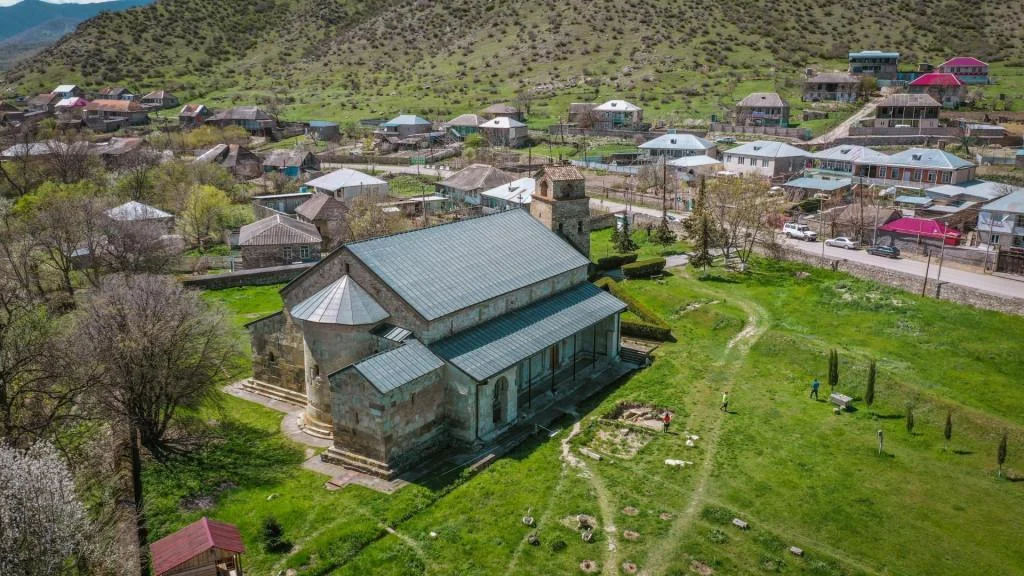
At first glance, the church appears remarkably solid. Broad walls of carefully cut greenish and turquoise tuff, a long pitched roof and relatively restrained façades give it a sense of permanence that feels entirely appropriate for a building that has stood for more than 1,500 years.
Bolnisi Sioni was constructed in the 5th century, between 478 and 493, and is considered one of the oldest and most significant surviving monuments of early Georgian Christian architecture. It is dedicated to the Dormition of the Mother of God and remains an active Georgian Orthodox church today.
Yet architecture is only part of its importance. Bolnisi Sioni preserves early stone sculpture, a famous form of the Georgian cross and inscriptions that are among the most important surviving records of the early Georgian written language.
Bolnisi Sioni at a Glance
| Detail | Information |
|---|---|
| Location | Bolnisi Municipality, Kvemo Kartli, Georgia |
| Construction | 478–493 AD |
| Architectural type | Three-nave basilica |
| Dedication | Dormition of the Mother of God |
| Famous for | Bolnisi inscriptions, Bolnisi Cross, early relief sculpture |
| Later additions | 8th-century chapel and 17th-century bell tower |
| Status | Active church and cultural monument |
| From Tbilisi | Roughly one hour by road to Bolnisi |
Bolnisi Sioni has held the status of an Immovable Cultural Monument of National Significance since 2006. Liturgical services continue to be celebrated in the church.
One of Georgia’s Earliest Great Churches
The scale of Bolnisi Sioni is striking when its age is considered.
Christianity had been established in the Georgian kingdom of Kartli during the 4th century, but Georgian church architecture was still developing its own recognizable forms when Bolnisi was constructed.
The result was a monumental three-nave basilica rooted in the wider architectural traditions of the early Christian world while already displaying features that would become characteristic of Georgian ecclesiastical architecture. Georgia’s official tourism portal dates construction to 478–493.
The central nave is separated from the side aisles by substantial columns and arches. At the eastern end lies the sanctuary and apse, while galleries and additional spaces extend along parts of the building.
Unlike later Georgian churches dominated by soaring central domes, Bolnisi Sioni is horizontal and grounded. Its architectural power comes largely from proportion, rhythm and mass.
The church does not need height to appear monumental.
The Turquoise-Green Stone of Bolnisi
One of the most memorable characteristics of the church is its colour.
Large parts of the building are faced with carefully cut blocks of greenish and turquoise-coloured tuff, a volcanic stone associated with the Bolnisi area. Georgia’s official tourism portal specifically identifies this local tuff as one of the building’s defining visual features.
Depending on the light, the walls can appear grey-green, blue-green or warmer in tone. Individual stones create subtle variations across surfaces that might otherwise seem severe.
This combination of massive construction and unusually coloured stone gives the basilica a distinctive appearance. From a distance it seems austere; closer inspection reveals much greater delicacy.
That contrast continues in the carvings.
Early Georgian Stone Carving
Bolnisi Sioni occupies an important place in the development of Georgian architectural sculpture.
The church contains both carved ornament and figurative reliefs. Among the motifs are geometric and plant patterns, crosses, birds and animal forms, including a bull’s head. Georgia’s official tourism authority describes Bolnisi Sioni as an early landmark for the simultaneous use of relief sculpture and carving in Georgian church decoration.
These images illustrate an interesting moment in Georgian cultural history.
Some decorative motifs have roots in artistic traditions that predate the country’s Christianization. Rather than disappearing completely, certain older visual forms were absorbed into a new Christian architectural language.
Crosses, meanwhile, became the dominant symbolic element.
And one particular form would become famous far beyond the walls of the church.
The Bolnisi Cross
Among the symbols carved at the church is the Bolnisi Cross, or Bolnuri Cross, one of the most recognizable historical cross forms associated with Georgia.
Its basic design places a cross within a circular frame, with widening arms giving the composition a highly distinctive appearance. Variations of the form appear several times in the decorative program of Bolnisi Sioni.
Today, the Bolnisi Cross can be seen well beyond the cathedral. It has been adapted in Georgian design, decorative art, jewellery and other cultural contexts.
At Bolnisi itself, however, visitors see the symbol where its historical association is strongest: carved into one of the country’s most important early Christian monuments.
The Bolnisi Inscriptions
For historians and linguists, the inscriptions may be even more important than the architecture.
Bolnisi Sioni preserves three particularly significant Georgian inscriptions connected with the construction of the church. They are written in Asomtavruli, the oldest monumental form of the Georgian script.
The inscriptions are sometimes casually described as the oldest Georgian writing, but the historical picture is more precise. Earlier Georgian inscriptions have been discovered in the Holy Land. The Bolnisi texts are nevertheless among the oldest surviving Georgian inscriptions and include one of the earliest securely dated examples found on Georgian territory.
One inscription mentions Bishop David, who was associated with the building of the church. Another provides information that allows scholars to date its construction.
The original of an important construction inscription is now preserved in the Georgian National Museum, while a reproduction occupies its architectural position at the church.
For anyone interested in the Georgian alphabet, Bolnisi Sioni is therefore not simply an architectural monument. It is also a landmark in the documentary history of the language.
Architecture Worth Looking at Closely
Bolnisi Sioni rewards slow observation.
Its broad central nave and side aisles form the basic basilican structure, while the surrounding galleries and ancillary spaces make the plan more complex than it first appears.
Arches within the early fabric display the horseshoe-like forms found in some early Georgian architecture. The distribution of carved decoration is also selective rather than excessive. Ornament was concentrated in particular architectural positions, creating visual emphasis without covering every surface.
A small chapel attached to the eastern side dates to around the 8th century, demonstrating that the site continued to develop long after the original basilica was completed.
The building visitors see today is therefore not frozen in the year 493. Like many ancient churches, it contains visible layers of damage, repair and changing liturgical use.
Destruction and Restoration in the 17th Century
Bolnisi Sioni survived the medieval period but suffered serious damage during the turbulent 17th century.
The Georgian Encyclopedia records particularly heavy damage during a Persian invasion in 1634, when sections of the vaulting and western wall were destroyed. This date is significant because some older travel descriptions give 1643 instead.
King Rostom of Kartli and Queen Mariam subsequently sponsored major repairs. Brick was used extensively in the reconstructed portions, making some later interventions distinguishable from the original stone fabric.
A western entrance was also introduced during this period.
Later in the 17th century, Bishop Nikoloz of Bolnisi commissioned further restoration and decoration. The nearby bell tower also belongs to this phase of the church’s history.
These changes mean that Bolnisi Sioni is valuable not only as a 5th-century monument but also as a physical record of centuries of destruction, repair and continued religious use.
The Return of an Active Church
The history of Bolnisi’s episcopal centre was interrupted during later periods of political and demographic change. According to the Georgian Encyclopedia, the Bolnisi Episcopacy was dissolved in the early 18th century.
Modern archaeological and architectural study of the monument developed during the 20th century. Research and restoration campaigns in the 1930s revealed previously hidden architectural features and fragments of inscriptions, while further conservation took place later in the century.
Bolnisi Sioni returned to functioning as a Georgian Orthodox church in 1989.
Today it is simultaneously a place of worship, a historic monument and an important destination for travellers interested in Georgia’s early Christian heritage.
How to Get to Bolnisi Sioni from Tbilisi
Bolnisi lies southwest of Tbilisi in the Kvemo Kartli region. Georgia’s national tourism portal gives a road journey of around one hour and five minutes from Tbilisi to Bolnisi, although actual travel time depends on traffic and your starting point in the capital.
A private car or taxi is the simplest option for travellers who want to combine the church with other monuments in the region.
Public transport can take visitors toward Bolnisi, but having independent transport makes a substantial difference if the goal is to see several dispersed historical sites on the same day.
The Bolnisi Tourist Information Center is located on Sulkhan-Saba Orbeliani Street and can provide local visitor information.
What to See Nearby
Bolnisi Sioni works particularly well as part of a full-day cultural trip through southern Georgia rather than as an isolated stop.
Nearby and easily combined attractions include:
- Tsughrughasheni Church, an elegant 13th-century domed church near Bolnisi; Bolnisi’s historic German district, associated with Swabian settlers who established Katharinenfeld in the 19th century; the Bolnisi Museum, with archaeological and regional collections; and the Dmanisi archaeological site, internationally known for early hominin discoveries dating back approximately 1.8 million years. Georgia’s tourism authority specifically promotes Bolnisi Sioni, Dmanisi and Tsughrughasheni together as a one-day regional itinerary.
That combination makes Bolnisi particularly appealing for travellers interested in long historical timelines. Within one day, it is possible to move from prehistoric archaeology to early Christianity, medieval architecture and the heritage of 19th-century European settlers.
Visiting Bolnisi Sioni
Because Bolnisi Sioni is an active Orthodox church, visitors should approach it as a place of worship rather than purely as a tourist attraction.
Quiet behaviour and respectful clothing are appropriate, particularly when services are taking place. Photography inside churches can sometimes be restricted or discouraged, so it is best to check locally before photographing the interior.
There is no need to rush the visit. Much of what makes Bolnisi important is easy to overlook from a distance: carved crosses, inscription panels, changes in masonry and architectural details become far more apparent when the exterior is examined carefully.
For travellers interested in architecture or history, allowing around an hour at the site is reasonable before continuing through the wider Bolnisi region.
Best Time to Visit
Bolnisi Sioni can be visited throughout the year.
Spring and autumn are particularly comfortable for combining the cathedral with other outdoor historical sites in Kvemo Kartli. Summer can be hot in southern Georgia, while winter occasionally brings colder conditions, although Bolnisi is considerably easier to access than Georgia’s high-mountain destinations.
Morning or late-afternoon light can also be particularly attractive for photography because the changing angle of the sun emphasizes the varied green, grey and warm tones of the tuff masonry.
Frequently Asked Questions
How old is Bolnisi Sioni?
Bolnisi Sioni was built between 478 and 493 AD, making it more than 1,500 years old and one of the oldest major surviving churches in Georgia.
Why is Bolnisi Sioni important?
Its importance comes from several elements at once: its early date, monumental basilican architecture, historic relief sculpture, the Bolnisi Cross and inscriptions that are among the earliest surviving examples of Georgian writing.
Are the Bolnisi inscriptions the oldest Georgian writing?
They are among the oldest surviving Georgian inscriptions and are especially important because they are securely dated and located in Georgia. Earlier Georgian inscriptions have been found in the Holy Land, so describing Bolnisi simply as the world’s oldest Georgian inscription would be inaccurate.
What is the Bolnisi Cross?
The Bolnisi Cross is a distinctive cross design associated with the 5th-century carvings at Bolnisi Sioni. Its arms widen toward their ends, and examples at the church appear within circular frames. It later became a widely recognized motif in Georgian visual culture.
Is Bolnisi Sioni still an active church?
Yes. Bolnisi Sioni is an active Georgian Orthodox church where religious services are held. The Georgian Encyclopedia records that the church resumed functioning in 1989.
Is Bolnisi Sioni a UNESCO World Heritage Site?
No. Bolnisi Sioni is an important nationally protected cultural monument, but it is not currently inscribed on UNESCO’s World Heritage List. UNESCO’s current listing for Georgia contains four World Heritage properties, and Bolnisi Sioni is not among them.
Why Bolnisi Sioni Is Worth Visiting
Georgia has no shortage of spectacular medieval monasteries and churches, but Bolnisi Sioni belongs to a much earlier chapter of the country’s history.
Its importance lies not in elaborate fresco cycles or a dramatic mountain setting. It lies in age, continuity and influence.
The basilica was standing when Georgian monumental Christian architecture was still taking shape. Its craftsmen worked with forms inherited from the wider late-antique world while beginning to create an architectural and decorative language that would develop in Georgia for centuries.
Its stone carvings preserve some of the earliest stages of that process. Its inscriptions capture the Georgian language in one of its oldest surviving monumental forms. Its walls show the scars of invasion and the masonry of later restoration.
More than fifteen centuries after construction began, Bolnisi Sioni is still fulfilling the purpose for which it was built.
For anyone exploring the cultural heritage of Georgia, that makes the journey south from Tbilisi well worth making.