
Discover the soul of Georgia’s capital on this Old Tbilisi City Tour, a relaxed 4–5 hour walk through the city’s most atmospheric streets, landmarks, and hidden corners. From Metekhi Plateau and Narikala Fortress to the sulfur baths, Meidan Square, ancient churches, caravanserais, and the Bridge of Peace, this tour reveals how Tbilisi blends centuries of history with everyday local life. Led by a professional guide, it is an ideal introduction for first-time visitors who want to understand the stories, culture, and character behind one of the Caucasus region’s most fascinating cities.
What you’ll see
Tour highlights
- Narikala Fortress — A 4th-century citadel with panoramic views that explain why every empire wanted this hilltop
- Scenic cable car ride — Soar above the Mtkvari River valley for a bird’s-eye orientation of the Old Town
- Sulfur bath district — The hot springs that gave Tbilisi its name and started its 1,500-year story
- Meidan Square — The old merchant heart of the city, where carved wooden balconies overhang cobblestones
- Ancient caravanserais — Silk Road trading posts, still standing, some now housing galleries and craft workshops
- Sioni Cathedral — Home to the grapevine cross of St. Nino, who made Georgia one of the world’s first Christian nations
- Anchiskhati Church — Tbilisi’s oldest surviving building, quietly watching since the 6th century
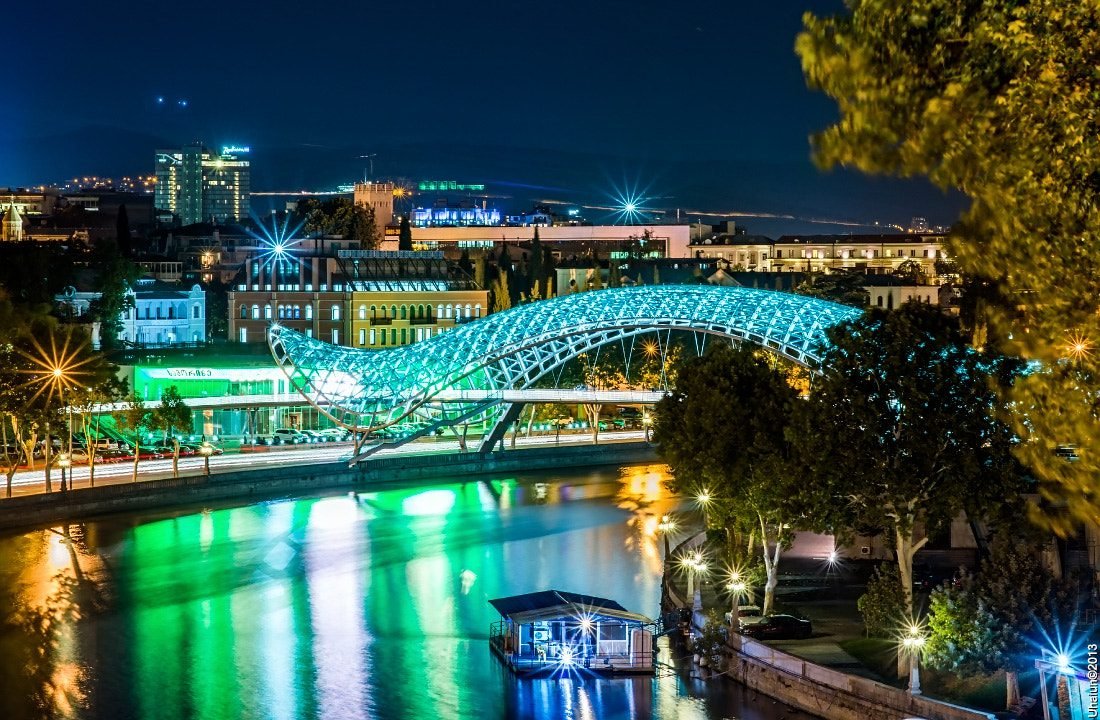
- Bridge of Peace — Glass-and-steel modernity spanning ancient riverbanks — Tbilisi in a single image
Step by step
Tour itinerary
How the day unfolds
Tbilisi doesn’t reveal itself in a straight line. The Old Town is built into a hillside, the river cuts it in two, and the layers of empire — Persian, Russian, Soviet, post-Soviet — sit on top of each other rather than next to each other. This tour is designed to make sense of that, on foot, in roughly four to five hours, with one cable car ride to handle the steepest climb.
1. Meeting point and orientation — Freedom Square
The tour begins where modern Tbilisi begins: Freedom Square (Tavisuplebis Moedani), with the gilded statue of St. George at its centre and the former Soviet city hall on its northern edge. Your guide will sketch out the route, point out where Rustaveli Avenue (the city’s main artery) heads north, and explain how the geography of the next four hours will work. From here, we walk downhill.
2. Sioni Cathedral
A few minutes’ walk brings you to Sioni Cathedral, the seat of Tbilisi’s bishopric for most of the city’s Christian history. The building itself has been destroyed and rebuilt so many times that “6th century” is more about the site than the stones. Inside is the cross of St. Nino — made, according to tradition, from grapevines bound with the saint’s own hair. Georgia converted to Christianity in 326 AD, making it one of the first three nations in the world to do so, and this cross is the relic that ties that story to a physical object you can stand in front of.
3. Anchiskhati Basilica and the Gabriadze Clock Tower
A short walk along Shavteli Street takes you past the leaning, hand-built Gabriadze Clock Tower — the work of the late puppet master Rezo Gabriadze, who decided Tbilisi needed something whimsical to balance all the seriousness. Behind it stands Anchiskhati Basilica, built in the 540s, the oldest surviving structure in Tbilisi. The interior is dim, candle-lit, and almost always quiet. It’s the kind of place where you lower your voice without being told to.
4. Bridge of Peace and Rike Park
From the basilica, we cross the Mtkvari River on the Bridge of Peace — a glass-and-steel pedestrian span opened in 2010 and immediately argued about. Some Tbilisians love it; others nickname it the “Always Ultra” for its shape. Either way, the view from the middle is one of the best free photographs in the city: Metekhi Church on the cliff to your right, the Old Town climbing up to Narikala on your left. We continue into Rike Park, where the cable car station sits at the riverbank.
5. Cable car to Narikala Fortress
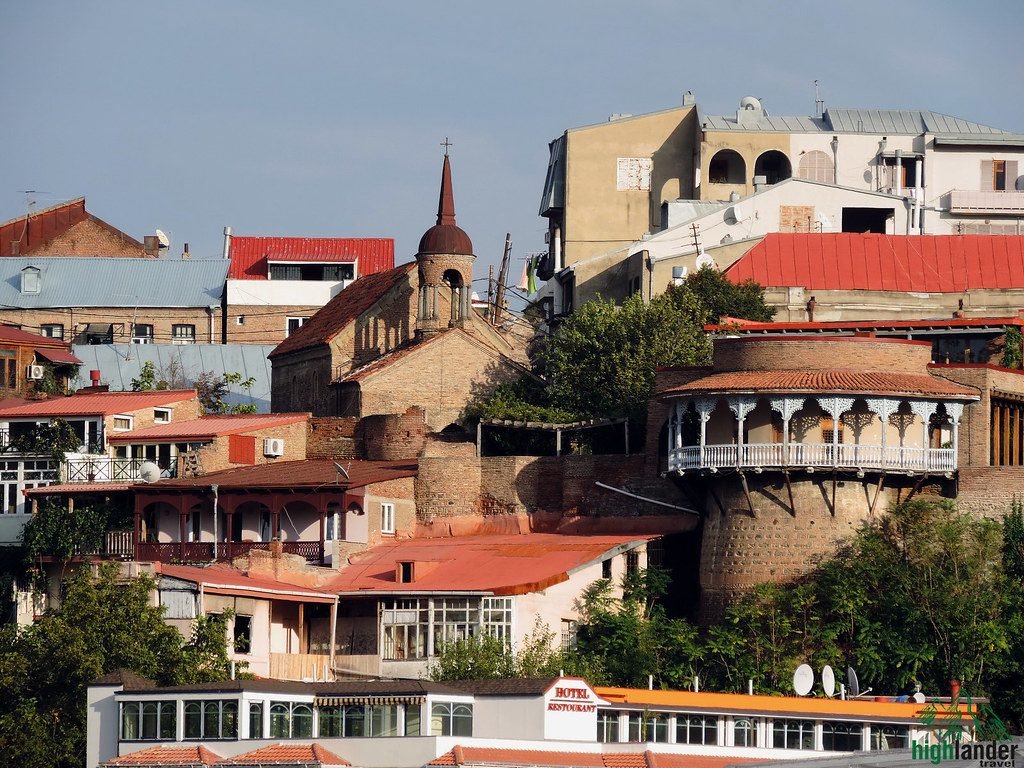
The ride takes about 90 seconds and gives you the entire Old Town from above — the corrugated rooftops, the wooden balconies stitched onto stone houses, the brick domes of the sulfur baths, the curve of the river. You step off at the foot of Narikala, the 4th-century citadel that every empire passing through the Caucasus wanted to control. The Persians built it. The Arabs expanded it. The Mongols sacked it. The Russians blew up its powder store in 1827. What you’re walking on now is mostly the surviving outer walls, plus the small reconstructed Church of St. Nicholas. The views down to the Botanical Gardens and across the city are the main event.
6. Kartlis Deda — the Mother of Georgia
A short walk along the ridge brings you to the aluminium statue of Kartlis Deda, raised in 1958 to mark Tbilisi’s 1,500th anniversary. She holds a sword in one hand and a bowl of wine in the other — the local explanation goes that one is for enemies and the other for guests, and a Georgian will tell you with a straight face that those are the only two categories that exist.
7. Descent into the sulfur bath district (Abanotubani)
From Kartlis Deda we walk down a steep cobbled path into Abanotubani, the district of the sulfur baths. According to legend, King Vakhtang Gorgasali was hunting here in the 5th century when his falcon caught a pheasant that fell into a hot spring and came out boiled. He founded the city on the spot. “Tbili” means “warm” in Georgian — Tbilisi is, literally, “the warm place.” The brick-domed bathhouses you see still work; Pushkin bathed here in 1829 and wrote that he had “never met anything more luxurious” than the baths of Tiflis.
8. Leghvtakhevi waterfall
Tucked into a narrow gorge just behind the baths is a 22-metre waterfall most visitors never realise is there. Five minutes off the main route, and you’re in what feels like a small canyon in the middle of the capital. Worth the detour.
9. Meidan Square and the caravanserais
Back in the Old Town, we end at Meidan Square — for centuries the trading heart of the city, where merchants from Persia, Armenia, Russia and the Ottoman empire bargained under the same arches. Two restored caravanserais now house galleries and craft shops. From here it’s a five-minute walk back to your starting point, or your guide can recommend where to stop for a glass of saperavi and a plate of khinkali before going on with your day.
Note: this is a private tour, so the pace and any small variations are flexible. If you want to spend longer at Narikala, skip a church, or add a stop at the Dry Bridge flea market, just tell your guide.
Starting from
€78
per person
Locally operated since 2011
We reply within 24 hours
What your price covers
What’s included
Included
- Licensed English-speaking private guide for the full duration of the tour
- Cable car ticket from Rike Park to Narikala Fortress
Not included
- Transport to and from the meeting point
- Lunch and any food during the tour
- Drinking water
- Museum entrance fees, if added on request
- Sulfur bath entry, if added on request
- Gratuities for the guide
Photographs
Gallery
Where you’ll go
Map & route
Freedom Square — meeting point
Sioni Cathedral
Anchiskhati Basilica / Clock Tower
Bridge of Peace & Rike Park
Narikala Fortress
Kartlis Deda (Mother of Georgia)
Abanotubani
Leghvtakhevi Waterfall
Meidan Square & Caravanserais
Practical details
Good to know before you go
Good to know before you go
What to wear
Comfortable closed shoes with grip — the Old Town is built on cobblestones polished smooth by a few centuries of foot traffic, and parts of the route are steep. Layers are sensible in spring and autumn; the temperature can shift by ten degrees between morning and afternoon. For visits to active churches (Sioni, Anchiskhati), women are expected to cover their shoulders and ideally their hair — most churches keep a basket of scarves at the door, but bringing your own light shawl is easier.
What to bring
- A bottle of water — there are kiosks along the route, but the climb up Narikala doesn’t have one
- Cash in Georgian lari (GEL) for snacks, tips, or any optional museum entry. ATMs are everywhere in the centre
- Sunscreen and a hat in summer; there’s limited shade on the Narikala ridge
- A camera or phone with battery — the views from the cable car and the fortress are the kind you’ll want
Best time of day to start
Morning tours (start around 10:00) are cooler in summer and quieter at Narikala. Afternoon tours (start around 14:00–15:00) end at golden hour, which is when the Old Town looks best from above. Both work — it depends on what kind of photographs you want and how you sleep on holiday.
Best season to take this tour
| Season | What it’s like | Best for |
|---|---|---|
| Spring (April–June) | Mild, often sunny, occasional showers; trees in blossom on Mtatsminda | First-time visitors, photography |
| Summer (July–August) | Hot (30–35°C), dry, full tourist season | Travellers combining Tbilisi with mountain regions |
| Autumn (September–November) | Warm days, cool evenings; harvest season, rtveli wine festivals | Food and wine travellers |
| Winter (December–March) | Cold (0–8°C), occasional snow, very few tourists | Quiet exploration, sulfur bath season, ski-trip stopovers |
Useful to know
- Georgian, English and Russian are widely spoken in the centre; restaurant menus are mostly in English and Georgian
- Tap water in Tbilisi is safe to drink — locals do
- Tipping the guide is appreciated if you enjoyed the tour, but never expected; 10–15% is normal
- The cable car runs from 11:00 to 23:00 daily; tours starting earlier visit Narikala on the way down
- Photographing inside active churches is restricted — your guide will tell you where it’s fine and where it isn’t
Who this tour is for
First-time visitors to Tbilisi, travellers on a short stopover (one or two nights) who want to understand the city quickly, and anyone who prefers a private guide to a 30-person walking group with a flag. It’s also a good first day in Georgia before heading off to Kakheti, Kazbegi, or Svaneti — the historical context you pick up here will make the rest of your trip make more sense.
Who it might not be for
Travellers with significant mobility limitations should let us know in advance — large parts of the Old Town can’t be done by wheelchair, and the Narikala descent is steep. If you’ve already spent several days in Tbilisi and seen the main landmarks independently, this tour will feel like a recap; in that case, a Kakheti wine-region day trip or a Kazbegi mountain day from Tbilisi will probably suit you better.
From our travellers
Reviews
2 Comments
Leave A Comment
Before you book
Frequently asked questions
How long does the Old Tbilisi City Tour take?
The tour usually takes around 4–5 hours, giving you enough time to explore the main landmarks of Old Tbilisi at a relaxed pace.
Is this tour suitable for first-time visitors?
Yes. This tour is ideal for first-time visitors, as it introduces Tbilisi’s history, architecture, culture, and most important Old Town sights in one experience.
What places will we visit during the tour?
The route includes highlights such as Metekhi Plateau, Narikala Fortress, the Sulfur Bath District, Meidan Square, Sioni Cathedral, Anchiskhati Church, the Bridge of Peace, and historic caravanserais.
Is the tour difficult?
The tour is considered easy to moderate. It involves walking through cobbled streets, some stairs, and slightly hilly areas, so comfortable shoes are recommended.
What should I bring with me?
Bring comfortable walking shoes, a bottle of water, sun protection in summer, and modest clothing for church visits. A camera or smartphone is also recommended, as Old Tbilisi offers many beautiful photo spots.
Ready when you are
Tell us your dates and how many of you are travelling. We’ll come back within 24 hours with availability, a confirmed price, and your guide’s name.




I did a day tour with Highlander Travel where we covered some notable sights in Tbilisi as well as the former capital of Georgia, Mtskheta. Rusudan from Highlander Travel made sure that I got to see all the main attractions while also giving plenty of information about the history of the places I saw and answering all my questions about the attractions which made my experience even better as my guide was well-informed about each and every place. The tour in Mtskheta was seamless and I saw the Cathedral which is one of the holiest sites in Georgia for Orthodox Christians and is also where members of the Royal family (Including the last King of Georgia) were buried. This along with the Jvari Monastery that overlooks Mtskheta from a high altitude makes it a must visit spot for the scenery, rich history and friendly locals. Highlander Travel is one of the most efficient and accommodating tour operators I’ve come across in Georgia so far and when we returned to Tbilisi for the city tour, I got to see many places which I had not heard of or researched about before traveling to Georgia which is another plus point as their tours are not the normal ones where you only see the main attractions and go but offer a more immersive and Georgian experience! Overall, I’d definitely go on more tours with them in the future when I return to Georgia with my family next time!
Very nice introduction to the city
We had very interesting walking tour in October with Rusudan. Very good experience.