Twelve days, seven regions, and about two and a half thousand kilometres. This is the long way around Georgia tour — east into the wine valleys, west across the country, north into the Caucasus for four nights, then south to the cave monasteries near the Turkish border and home across a volcanic plateau.
The part that makes it worth twelve days rather than eight is Svaneti. Three nights in Mestia and one in Becho, which is enough to walk to a glacier, take a jeep up the Ushguli road, and spend a day above the treeline instead of photographing the mountains from a car park. Most tours give Svaneti one day. This one gives it four, and that is the difference between seeing it and being in it.
Then the other half of the country, which almost nobody covers in the same trip: Vardzia, six thousand chambers cut thirteen storeys into a cliff; Rabati, where a mosque, a synagogue and two churches stand inside one set of walls; and the Javakheti plateau at two thousand metres, treeless and windswept, where the villages speak Armenian.
It is not a restful holiday and we would rather say so now. Two of the days are twelve-kilometre hikes. Two more are six or seven hours in the vehicle on mountain roads. You sleep in family guesthouses for seven of the eleven nights — clean, private, warmly fed, and nothing like a hotel. If that sounds like the trip you want, it is the best twelve days we know how to build.
What you’ll see
Tour highlights
- Four nights in Svaneti. Three in Mestia and one in Becho — the only tour we run that gives the region enough time to walk in it rather than drive through it.
- Chalaadi Glacier on foot. Twelve kilometres up the Mestiachala valley to a glacier face that is actively breaking apart. You hear it before you see it.
- The Ushguli road. Forty-five kilometres, three hours, river crossings with no bridges, and at the end four hamlets under Shkhara with more than two hundred medieval towers between them.
- Shdugra waterfall. A day above the treeline in the Dolra valley, through meadows that are solid wildflowers in July, to a thirty-metre glacier-fed cascade.
- Vardzia. A twelfth-century monastery cut thirteen storeys into a cliff, six thousand chambers at its height, opened to the air by the earthquake of 1283.
- Uplistsikhe. A town carved out of volcanic rock and lived in from about 1000 BC — streets, a theatre, a pagan temple that became a church.
- Kakheti in a full day. Ikalto’s medieval academy and its wine cellar, Gremi’s Silk Road fortress, a qvevri tasting, and Sighnaghi on its hilltop above the Alazani.
- Rabati and Sapara. An Ottoman fortress holding a mosque, a synagogue and two churches inside one wall — and, twelve kilometres away down a wooded gorge, a thirteenth-century monastery with frescoes that survived because the Turks converted the church instead of destroying it.
- The Javakheti plateau. Volcanic highland at 2,000 m on the drive home — Paravani, Georgia’s largest lake, treeless grassland, and Armenian villages that look like nowhere else in the country.
Step by step
Tour itinerary
Day 1 — Arrival in Tbilisi
We meet you at the airport whatever time you land and take you into the city. If you arrive in the morning you have the afternoon free — walk the neighbourhood, find somewhere for dinner, let the time zone settle. If you come in late, sleep, because tomorrow is on foot.
Overnight Tbilisi, central hotel
Day 2 — Tbilisi
Tbilisi is a city built in layers and the old town shows all of them at once. We start at Abanotubani, the sulphur bath quarter, which is where the city began in the fifth century around the hot springs — the brick domes in the ground are the bathhouse roofs. Up to Narikala by cable car for the view: a fourth-century fortress rebuilt by every power that took the city, and from the ridge you can see how Tbilisi is wedged into a valley between two ranges.
Down to Metekhi, thirteenth century, on the cliff above the river where the royal quarter stood — it survived the Soviet period by being turned into a theatre. Then Rustaveli Avenue for the other Georgia: Imperial Russian facades, Soviet blocks and new glass along one boulevard.
Dinner is a proper Georgian table, which means a supra — a meal organised around toasts, where the talking matters as much as the food and somebody is appointed to run it.
Walking 4–5 km · welcome dinner included · overnight Tbilisi
Day 3 — Kakheti: Telavi, Ikalto, Gremi and Sighnaghi
A long day east and a full one. Kakheti makes seventy per cent of Georgia’s wine, in a valley between the Greater and Lesser Caucasus, from grape varieties that mostly grow nowhere else — and the archaeology puts winemaking here at eight thousand years.
Telavi for the market. Ikalto, eighth century, which housed one of Georgia’s first academies — philosophy, rhetoric and astronomy — and still has the monks’ wine cellar with its qvevri sunk into the floor. Gremi, a Silk Road capital until Shah Abbas destroyed it in 1615; from the tower the Alazani valley runs all the way to the mountains.
Lunch is at a family winery with a tasting — four or five wines, made in clay buried to the neck, alongside food built to go with them. Then Sighnaghi, on its hill above the valley, walled by Erekle II in the eighteenth century with four kilometres of rampart and twenty-eight towers still standing. On a clear afternoon you can see into Azerbaijan.
Driving 5–6 h · walking 3–4 km · a long day, back in Tbilisi late · wine lunch included · overnight Tbilisi
Day 4 — Mtskheta, Uplistsikhe and west to Kutaisi
Jvari stands on a bare hill above the meeting of the Aragvi and the Mtkvari — sixth century, and the model church builders across the Caucasus copied for the next five hundred years. Below it, Mtskheta was the capital for a thousand years and is still the country’s spiritual centre; Svetitskhoveli is where the kings were crowned and buried, on ground that has held a church since the fourth century.
Then Uplistsikhe, and it is worth arriving without expectations. From about 1000 BC people cut an entire town into soft volcanic rock — streets, houses, a theatre, a water system, and at its height something like twenty thousand people. You walk through it. Halfway round you pass a pagan temple that was reworked into a Christian church, which tells you the whole story in one room.
West to Kutaisi, and one more stop before the hotel: Gelati, twelfth century, founded by David the Builder with an academy that pulled scholars from across the Middle East and Europe. The mosaics are the high point of medieval Georgian art.
Driving 5–6 h · walking 3–4 km · overnight Kutaisi
Day 5 — Okatse Canyon and the road into Svaneti
Half an hour out of Kutaisi, Okatse has a steel walkway bolted to the cliff — seven hundred and eighty metres of it, with the river twenty to thirty metres below and limestone the water has been shaping for a very long time.
Then the drive that changes the trip. Six hours from Kutaisi to Mestia, following the Enguri up into the High Caucasus and gaining more than fifteen hundred metres. The last stretch is partly unpaved and cut into steep ground. Somewhere in the middle of it you understand why Svaneti stayed separate from the rest of Georgia for so long: the mountains do the work of a wall.
Into Mestia in the evening, at 1,500 m under Ushba, with the air noticeably thinner and colder than the lowlands you left this morning.
Driving 6–7 h · walking 2–3 km · overnight Mestia, all meals
Day 6 — Mestia’s towers, then Chalaadi Glacier
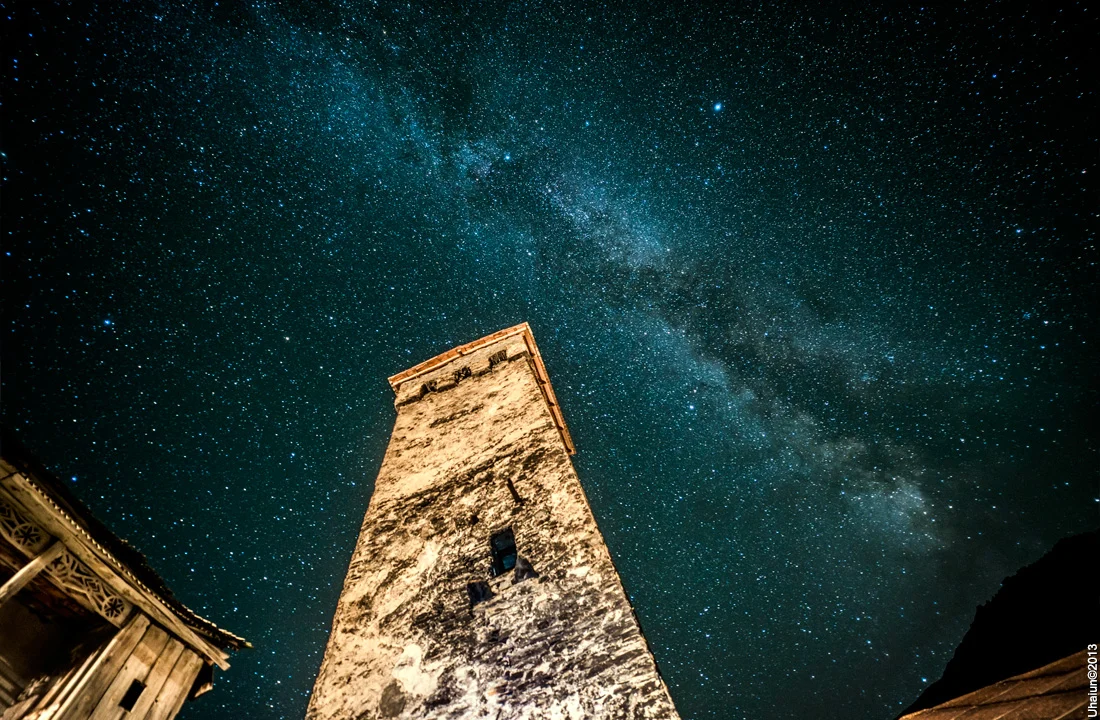
The morning belongs to the towers. Svan families built them between the ninth and thirteenth centuries, one per household, and when a feud or an invasion started everyone climbed into their own and waited. Nothing quite like them exists anywhere else — it took the right stone, real isolation, and constant danger. The Svaneti Museum holds the icons and worked silver that were hidden inside them for centuries, some of it ninth century.
Then the walk. Chalaadi Glacier starts at Lenjeri, ten minutes out, and follows the Mestiachala up through pine and alpine meadow, over wooden bridges across meltwater, steepening at the end. Twelve kilometres there and back, five to six hours, topping out near two thousand metres. The glacier comes down off Ushba and it is actively calving — you hear it crack and shift while you stand there, and the ice is that particular blue.
Hiking 12 km, 5–6 h · overnight Mestia, all meals
Day 7 — Ushguli by jeep
Forty-five kilometres and two and a half to three hours each way, because no ordinary vehicle goes up there. We take 4×4s. The road fords rivers with no bridges, climbs passes and runs along cliff edges, and the roughness is the reason Ushguli is what it is.
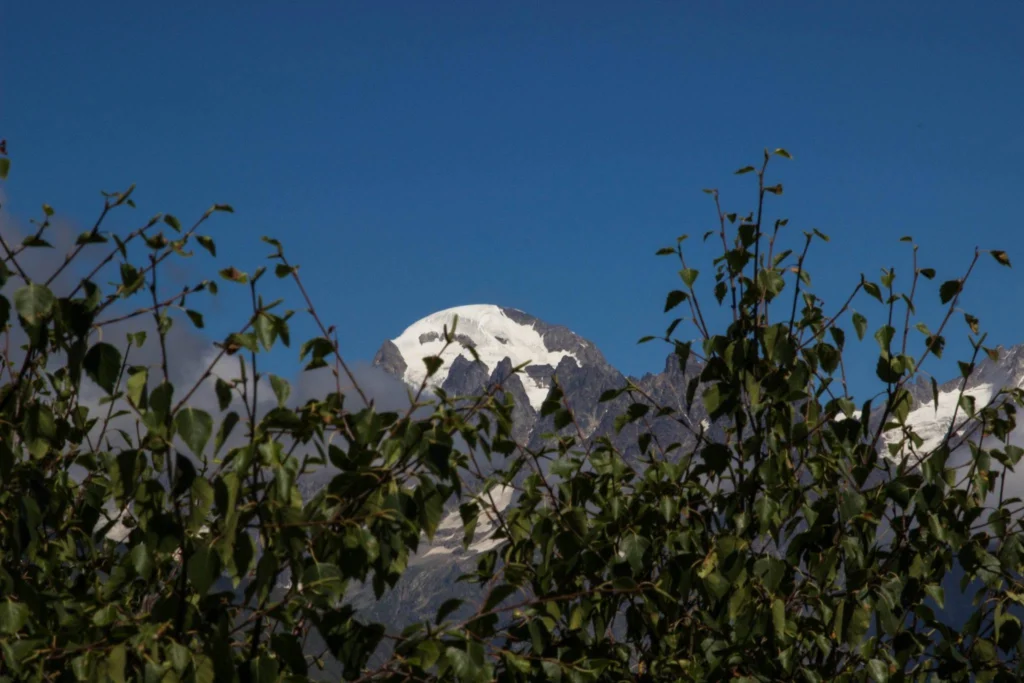
Ushguli is four hamlets at 2,100 m, holding around seventy families year-round, with more than two hundred towers between them — the densest concentration in Svaneti, and the reason Upper Svaneti is a World Heritage Site. Shkhara stands directly above: 5,193 m, Georgia’s highest, glacier-covered, and close enough that the contrast with people going about an ordinary morning underneath it takes a while to process.
Walk the stone lanes between the towers — ground floor for animals, middle floors for the family, top for defence. Some households will show you theirs. The twelfth-century Lamaria church above the village has frescoes that isolation preserved.
Back down the same road, in different light.
Driving 5–6 h return by 4×4 · walking 3–4 km · overnight Mestia, all meals
Day 8 — Becho and the Shdugra waterfall
Forty-five minutes deeper into the range to Becho, in the valley below Ushba and a good deal quieter than Mestia.
The Shdugra trail runs up the Dolra through pine and then out above the treeline into meadow — in July that meadow is solid with flowers — with the peaks opening out on both sides as the valley widens. Twelve kilometres round trip, about four hundred metres of climb, five to six hours, topping out near 2,300 m. The falls drop around thirty metres in stages, straight off a glacier, and the water is the colour glacial silt makes it. Horses can be arranged in advance for part of the route, around 50–60 GEL; the last section to the falls is on foot either way.
Tonight is the most basic bed of the trip and the one people remember: a Becho guesthouse, simple rooms, everyone eating at one table, and the electricity taking the occasional evening off.
Hiking 12 km, 5–6 h, +400 m · overnight Becho, all meals
Day 9 — Out of the mountains, Prometheus Cave, Borjomi
The longest day, and worth knowing about in advance: we are on the road from after breakfast until the evening. Back down the Enguri to Kutaisi, then south.
Prometheus Cave breaks the drive — 1.6 km of developed passage through stalactite chambers, an underground river and lakes, at a steady 14 °C. The coloured lighting divides people; the formations behind it do not.
Borjomi in the evening. The Russians built it as a spa in the nineteenth century around the mineral springs, and the water is still the most recognisable Georgian export there is. If there is light left, the walk up the park along the river to the original spring is worth it — the water comes out warm, around 38 °C, and tastes strongly of what is in it.
Driving 7–8 h · plus the cave and the park, so a long day end to end · overnight near Borjomi
Day 10 — Rabati, Sapara and Saro
A shorter day, deliberately, after yesterday. Rabati dominates Akhaltsikhe — thirteenth century in origin, rebuilt under two hundred and fifty years of Ottoman rule and again by the Russians, and inside one set of walls it holds a mosque, an Orthodox church, a Catholic church and a synagogue. That is not decoration; it is who lived here.
Twelve kilometres away, down a wooded gorge, Sapara is the opposite: a working monastery, tenth century in foundation with a thirteenth-century main church, hard to find and holding some of the best frescoes in southern Georgia. They survived because the Ottomans converted the church rather than knocking it down.
Then Saro, a nearly empty village of stone houses high above the Mtkvari gorge, with the remains of a cyclopean wall on the hill behind it — prehistoric, unexplained, and visited by almost nobody.
Driving 2–3 h · walking 3–5 km · overnight near Akhaltsikhe
Day 11 — Vardzia at dawn, then home across Javakheti
Early, so that we are at Vardzia before the coaches and before the heat.
Queen Tamar’s masons cut it into the cliff above the Mtkvari in the twelfth century, and at its height it held around two thousand monks in six thousand chambers across thirteen storeys — churches, stores, libraries, and a water system that lifted water four hundred and fifty metres from the river. The earthquake of 1283 took away roughly two-thirds of it and, in doing so, opened the inside of the mountain to the air. What is left is still enormous. The Church of the Dormition has a portrait of Tamar painted while she was alive, and a handful of monks still live there.
Khertvisi on the way north, where the Mtkvari meets the Paravani — a fortress on that ridge since at least the second century BC, guarding the road to Armenia and Turkey.
Then the Javakheti plateau, and the country changes one last time: volcanic highland around two thousand metres, treeless, wind-scoured, with dormant cones on the skyline and Armenia’s Mount Aragats visible to the south. We stop at Paravani, Georgia’s largest lake, and at Sagamo. Tbilisi in the evening.
Driving 5–6 h · walking 2–3 km · overnight Tbilisi
Day 12 — Departure
Breakfast, and free time if your flight allows it — most people use it to go back to one thing in the old town they only half saw on Day 2. Transfer to the airport to suit your departure.
Transfer to Tbilisi International Airport
Starting from
€2,640
per person
Locally operated since 2011
We reply within 24 hours
What your price covers
What’s included
Included
- Airport transfers on arrival and departure
- All transport in a private, mountain-capable vehicle for twelve days
- 4×4 with a local driver for the Ushguli road on Day 7
- English-speaking driver-guide throughout
- Eleven nights’ accommodation: hotels in Tbilisi, guesthouses everywhere else, private room and bathroom in all of them
- Breakfast every day
- All meals in Svaneti — Days 5 to 9, breakfast, dinner and packed lunches on the hiking days
- Welcome dinner in Tbilisi on Day 2 and the winery lunch with tasting on Day 3
- Every entrance fee on the itinerary: Uplistsikhe, Gelati, Okatse, the Mestia museums, Ushguli, Prometheus Cave, Rabati, Vardzia
- All local taxes
Not included
- Flights to and from Georgia
- Travel and medical insurance — compulsory on this tour, and it must cover hiking to 2,400 m and evacuation from a mountain region
- Lunches and dinners outside Svaneti — Days 1–4 and 9–12. Budget $16–27 a head at a local restaurant
- Alcohol outside the included tastings
- Horses on the Shdugra trail if you want them, about 50–60 GEL, arranged in advance
- Single room supplement — see the price table
- Personal spending and souvenirs
- Tips for your guide
Photographs
Gallery
Where you’ll go
Map & route
Practical details
Good to know before you go
Duration and start point
Twelve days, eleven nights. Begins and ends at Tbilisi International Airport, with transfers timed to your flights.
Season
June to September only. The Ushguli road and the high trails are under snow the rest of the year and Svaneti — which is four of the eleven nights — is effectively closed. July and August are the most reliable and the busiest. June gives you wildflowers and fewer people, with a risk that late snow keeps the Ushguli road shut. September brings the first autumn colour and shorter days. We do not run this itinerary between October and May, and if you want those months, ask us about the same route without the mountain section.
Fitness — read this before you book
Challenging. Two days are twelve-kilometre hikes over uneven ground at altitude, one of them with four hundred metres of climbing, both reaching above 2,000 m. Other days include several hours on rough mountain roads. You should be comfortable walking four to six hours with a daypack and breaks. This tour is not suitable if you have significant knee or back problems, if you cannot walk more than two or three hours at a time, or for very young children.
Group size
One to eight people, your group only. Above eight we need a second vehicle and a second guide, which changes the price — ask and we will quote it properly.
Accommodation
Four nights in Tbilisi hotels. Seven in family guesthouses — Kutaisi, Mestia, Becho, Borjomi and Akhaltsikhe. All of them have private rooms with private bathrooms. None of them is a hotel: expect simple, clean, well-heated rooms and generous home cooking, and expect the Becho night to be the most basic of the trip.
Roads and driving
About 2,600 km over twelve days. Day 5 into Svaneti is six to seven hours and Day 9 out of it is seven to eight, both on winding mountain roads with unpaved sections. If you are prone to motion sickness, bring what works for you — the scenery is worth the road, but the road is real.
Weather in the mountains
Mestia runs 15–20 °C by day in summer and Ushguli is three to five degrees colder; nights drop to 5–10 °C even in August, and snow at 2,100 m is possible in any month. Rain can close the Ushguli road or turn the trails to mud. We carry alternatives for every Svaneti day and we will use them rather than push.
Money
Mestia has cash machines but they run dry and they fail. Bring 200–300 GEL per person in cash from Tbilisi for the Svaneti days. Cards are accepted almost nowhere in the mountain villages.
Connectivity
Most guesthouses have wifi and most of it is slow. Messaging and email generally work; video calls generally do not. Some stretches between towns have no signal at all.
What to bring
Broken-in hiking boots with ankle support — not new ones. A waterproof jacket and overtrousers. A fleece or light down layer for the mountain evenings. A 25–30 litre daypack, one to two litres of water capacity, sun hat, sunglasses, high-factor sun cream. Trekking poles if you use them. A headlamp, because the power does go off. Blister plasters and your own medication. And something modest to wear into churches.
From our travellers
Reviews
Before you book
Frequently asked questions
How much does the 12-day tour cost?
Per person, depending on group size: $4,450 for one traveller, $2,645 each for two, $2,040 each for three or four, $1,560 each for five or six, and $1,355 each for seven or eight. That covers eleven nights, all transport including the 4×4 day, your driver-guide for twelve days, breakfast throughout, every meal in Svaneti, the welcome dinner, the winery lunch and all entrance fees.
What fitness level do I need?
You should be comfortable hiking four to six hours over uneven mountain ground carrying a daypack, and willing to do it twice in three days. Regular walking, running or cycling at home is enough preparation. Two days are twelve kilometres each, one with four hundred metres of climbing, both reaching above 2,000 m — and altitude makes a walk harder than the distance suggests. If you are unsure, tell us your longest recent walk and we will give you an honest answer.
What if someone in our group does not want to hike?
On Day 6 that is easy: Mestia has museums, towers and cafés, and you can spend the day there while the others walk to the glacier. Day 8 is harder, because the walk starts from Becho and the group sleeps there — the options are a shorter section of the same trail, horses for part of the route, or a quiet day in the village. Tell us when you book and we will plan around it rather than improvise on the morning.
When can this tour run?
June to September. The Ushguli road and the high trails are under snow the rest of the year, and Svaneti is four of the eleven nights, so there is no version of this itinerary that works in April or October. If you want those months, ask us about the same route without the mountain section.
How cold does it get in Svaneti?
Mestia sits around 15–20 °C by day in summer; Ushguli is three to five degrees colder. Nights drop to 5–10 °C even in July and August, and it is colder again with wind on the trails. At 2,100 m, snow is possible in any month. Bring a fleece or a light down layer for evenings and early starts.
What happens if bad weather closes the mountain roads?
We check conditions daily. If the Ushguli road is shut we substitute another Svaneti day — a different valley, a lower walk, the museums. If the weather were severe enough to make the region unworkable altogether we would move the itinerary to other regions at no extra cost. Individual days do get rearranged most seasons. No trip has been cancelled for weather.
Are there cash machines in Svaneti?
Mestia has them, and they run out of cash or stop working often enough that you should not rely on them. Bring 200–300 GEL per person from Tbilisi to cover your Svaneti days. Cards are accepted in very few places in the mountain villages.
Can you cater for vegetarians or vegans?
Vegetarian, yes, easily — Georgian cooking has good vegetarian dishes at every meal and the guesthouses handle it without fuss. Vegan takes more arranging because cheese and eggs are in most things, and it is entirely doable if you tell us when you book so we can brief the guesthouses in advance.
Is there wifi in the guesthouses?
Most have it and most of it is slow. Messaging and email usually work. Video calls and streaming usually do not. There are stretches between towns with no signal at all, and Becho on Day 8 has the least of everything.
Do I need travel insurance?
Yes, and it is compulsory for this tour. Your policy must cover hiking to 2,400 metres and evacuation from a remote mountain region, alongside the usual medical and cancellation cover. We will ask to see it before departure.
Can solo travellers join, and what is the group size?
Yes. The tour runs for one to eight people and it is your group only — we do not combine bookings unless you ask us to. Solo travellers pay the single-traveller rate above, which covers the private room throughout. If you would like us to try to pair you with another solo traveller on matching dates, say so and we will look.
Ready when you are
Tell us your dates and how many of you are travelling. We’ll come back within 24 hours with availability, a confirmed price, and your guide’s name.