
THE LAND THE GREEKS CALLED COLCHIS
Why Samegrelo Matters
Most people cross Samegrelo without stopping. They take the train to Zugdidi, sleep through the last two hours of it, and climb into a marshrutka bound for Svaneti before the coffee stalls have opened. The region becomes a corridor: something between the airport and the mountains.
Get off the train earlier.
This is the flattest, wettest, greenest part of Georgia, and it hides more history per kilometre than anywhere else in the country. The Greeks sailed here for the Golden Fleece. The Romans garrisoned it. Byzantine armies and Persian armies fought over a fortress on the Tekhuri River that you can still walk through, tunnel and all. A princely family ruled from Zugdidi for six hundred years, married into Napoleon’s, and left the death mask to prove it.
And then there is the water. Samegrelo sits where the Rioni, the Enguri and the Tskhenistskali empty out of the Caucasus toward the Black Sea, and the rain that feeds them falls almost all year. It shows. Limestone canyons run turquoise even in January. Wetlands south of Poti absorb whole flocks of migrating birds. Hazelnut orchards and bay laurel hedges close in on the roads, and in September the smell of drying nuts hangs over every village between Senaki and Chkhorotsku.
The mountains at the back of it are the Egrisi Range, and they hold Tobavarchkhili — the Silver Lake — at 2,650 metres. It takes four days on foot to reach. Almost nobody goes.
AT A GLANCE
Key Facts
Location
Western Georgia, between the Black Sea and the Egrisi Range
Main towns
Zugdidi (regional capital), Poti, Senaki, Martvili, Tsalenjikha, Chkhorotsku
Climate
Humid subtropical. Hot summers, mild winters, rain in every season
Languages
Georgian and Megrelian. English in tourist businesses, Russian widely understood
Highest point
Tobavarchkhili lakes sit at 2,650m in the Egrisi Range
Getting around
Marshrutkas between towns; a hired car or driver for canyons and villages
ATMs and cards
Reliable in Zugdidi, Poti and Senaki. Carry cash for village guesthouses
Nothing Found
MYTH, THEN PAPERWORK
Colchis, the Fleece and What Came After
When Jason sailed east for the Golden Fleece, this is where the Argo was heading. Colchis was a real kingdom, not a poetic invention: it traded metals and timber along the eastern Black Sea from roughly the 6th century BCE, and Greek colonists set up ports on its shore, including one at the mouth of the Phasis — today’s Rioni, today’s Poti.
The fleece part has a workable explanation. Mountain communities in the western Caucasus panned river gold by pegging sheepskins into the current; the wool caught the flakes, and a fleece pulled from the water after a season’s work came out heavy and glinting. Whether that practice inspired the myth or the myth was retrofitted to it, nobody can prove.
Either way, the gold was in the rivers, and the rivers are still here.
Rome absorbed Colchis in the 1st century BCE. Its successor, the kingdom of Lazica — Egrisi in Georgian — spent the 6th century as the pivot of a long war between Byzantium and Sasanian Persia, and the fortress at Nokalakevi was its capital. Later the region became Odishi, ruled by the Dadiani family from the 13th century onward. The principality survived Ottoman pressure, Russian protection, and its own dynastic feuds until it was abolished in 1857 and folded into the Russian Empire.
The Megrelian language came through all of it. It belongs to the same Kartvelian family as Georgian and Svan but split off much earlier, and the two are not mutually intelligible. There is no separate script and no literary standard; people write in Georgian and speak Megrelian at home, in the market, at the table. UNESCO lists it as definitely endangered. You will hear it constantly, and you will not recognise a word.
ROUTES INTO THE REGION
Getting to Samegrelo
Samegrelo is the easiest mountain-adjacent region in Georgia to reach. It has a working railway, a flat main highway and an international airport ninety minutes away.
Train from Tbilisi to Zugdidi
The daytime service leaves Tbilisi around 08:25 and reaches Zugdidi around 14:11, with the return departing Zugdidi in the late afternoon. Journey time is a little under six hours. Second class costs about 16 GEL, first class about 28 GEL, and first class is worth the difference for the legroom and the power sockets.
Book through TKT.GE or at Tbilisi Central Station. Seats are assigned automatically, so travelling companions are not always seated together. Timetables shift with the season — confirm before you plan a connection.
Marshrutka and private transfer
Minibuses run from Tbilisi’s Didube station to Zugdidi through the day: 5.5 to 6 hours, 20 to 25 GEL, no assigned seats and no promises about legroom. Senaki, Poti and Martvili are served from the same station.
A private transfer costs considerably more but turns the drive into the trip. The road from Tbilisi passes Gori, Kutaisi and the edge of Imereti, and a driver will happily stop at Nokalakevi or Martvili Canyon on the way.
Kutaisi airport
Kutaisi International is the closest airport to Samegrelo and the arrival point for most low-cost flights from Europe. Zugdidi is roughly 100 km away, around 1.5 to 2 hours by road; Martvili Canyon is closer still. Flying into Kutaisi and starting your Georgian trip in the west, rather than backtracking from Tbilisi, saves a full day.
Zugdidi to Mestia and Svaneti
Marshrutkas to Mestia leave from near Zugdidi railway station, timed to meet the train: 3.5 to 4 hours, 25 to 30 GEL. This is the reason most travellers pass through Samegrelo, and it is exactly why a two-night stop here before the mountains works so well. You arrive in Svaneti rested instead of shattered.
SEASON BY SEASON
When to Visit
There is no dry season in Samegrelo. There are seasons with less rain, and there are seasons where the rain arrives warm. Pack accordingly and the weather stops mattering.
| Season | What it’s like | Best for | Watch out for |
|---|---|---|---|
| April–May | Green, wet, 18–24°C. Canyons at full flow | Waterfalls, bird migration, photography | Boat rides suspended after heavy rain |
| June–August | Hot and humid, 28–33°C on the plain | Beaches, high mountain trekking, swimming holes | Tour buses at Martvili, mosquitoes in the wetlands |
| September–October | Warm days, cooler nights, harvest everywhere | Ojaleshi harvest, canyons without crowds, hiking | Shorter days; high passes close from mid-October |
| November–March | Mild, 6–14°C, grey and wet, rarely freezing | Museums, monasteries, empty canyons | Reduced opening hours; mountain routes closed |
Best months overall
May, September and early October. Warm, green, and the canyon walkways aren’t queued.
Best for trekking
Late July to mid-September, when the Egrisi passes are clear of snow.
Best for birdwatching
Early spring and autumn at Kolkheti, when the migration routes are busiest.
Best for the coast
July and August, when the Black Sea is warm enough to swim comfortably.
THE REGIONAL CAPITAL
Zugdidi
Zugdidi will not charm you at first sight. It is a working town of about 42,000 people with Soviet apartment blocks, a loud bazaar and traffic that ignores lane markings. Give it an afternoon and it turns into one of the more interesting stops in western Georgia.
The town grew up around the Dadiani residence, and the palace grounds still sit in the middle of it like a piece of a different country. Around them, the market sells bay leaves by the sackful, walnut paste by the jar, and enough varieties of homemade ajika to ruin your luggage.
Dadiani Palace Museum
The Dadiani ruled Odishi for roughly six hundred years, and their palace holds what a dynasty accumulates over that long: manuscripts, icons, coins, weapons, and around 45,000 catalogued objects. The collection dates back to 1839, which makes it one of the oldest museum holdings in the Caucasus; it opened to the public as a state museum in 1921. The English architect Edwin Race gave the main building its neo-Gothic face in the 19th century, and the result borrows from Georgian, Russian, Islamic and Tudor architecture without settling on any of them.
The object everyone comes for is a bronze death mask of Napoleon Bonaparte — one of only a handful ever cast. It reached Zugdidi through marriage. Salome Dadiani, daughter of Prince David Dadiani, married Achille Murat, grandson of Napoleon’s sister Caroline, and the family’s Bonaparte relics travelled east with him.
Take the guided tour. Without it, the rooms read as furniture; with it, they read as a family that spent six hundred years balancing between empires.
Hours: 10:00–18:00, closed Mondays. Entry: around 5 GEL, plus about 5 GEL for an English-speaking guide. Time needed: 1.5–2 hours.
Zugdidi Botanical Garden
Laid out beside the palace in the 1840s by Ekaterine Chavchavadze-Dadiani, the garden is the reason Zugdidi smells of magnolia in May. Subtropical species from Japan, the Americas and the Mediterranean were planted here when the climate was still being tested against exotics, and many of them are now enormous.
It is free, it is shady, and after the museum it functions as an air-conditioned room with no walls.
Eating and sleeping in Zugdidi
Zugdidi is the best place in Georgia to eat Megrelian food cooked by Megrelians. Ask for elarji, kupati and gebzhalia, and be honest with the waiter about your tolerance for chilli — this is the spiciest regional cooking in the country, and nobody will be offended if you ask for the ajika on the side.
Accommodation runs from family guesthouses at 60–100 GEL with breakfast to mid-range hotels at 150–250 GEL. Guesthouse dinners are usually better than restaurant dinners, and their hosts will happily arrange a driver for the canyons at a fraction of an agency price.
Rukhi Fortress
Fifteen minutes north of town on the Enguri road, this 17th-century Dadiani stronghold has been restored to the point of controversy — some of the masonry is unmistakably new. Climb the tower anyway. From the top you get the whole layout of the lower Enguri valley, the fortress’s original reason for existing, laid out in one view.
LIMESTONE AND MELTWATER
Canyons and Waterfalls
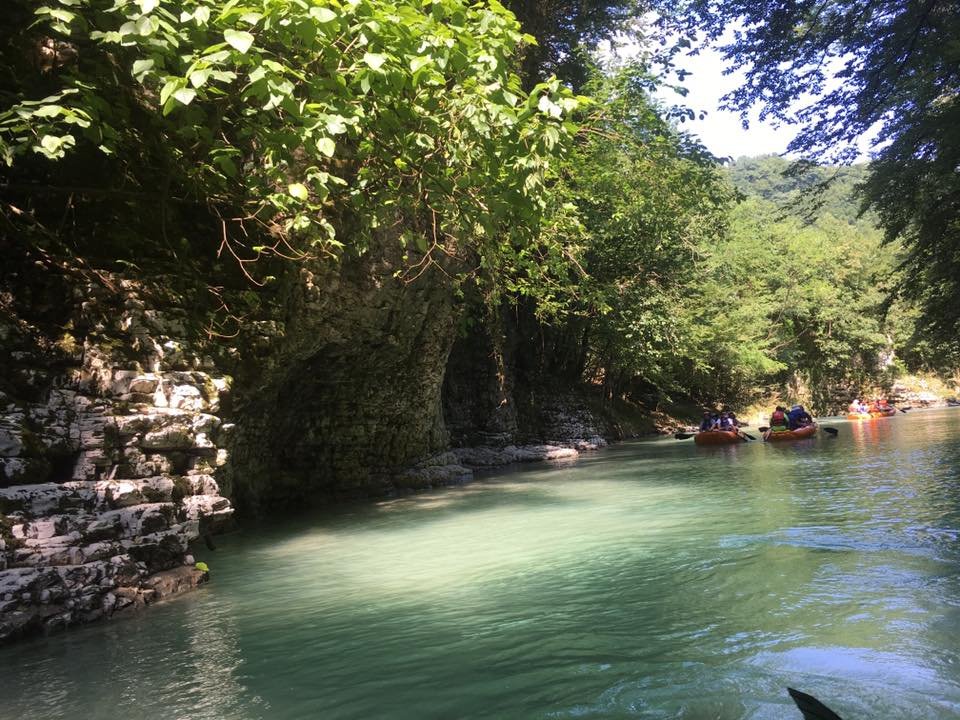
The limestone belt running along the foot of the Egrisi Range has been cut into gorges by rivers that never dry up. The water is that particular opaque turquoise that comes from suspended limestone — the colour of glacier melt, without a glacier anywhere near.
Martvili Canyon
The Abasha River has carved a 40-metre-deep slot through the limestone here, and a 700-metre paved loop with bridges and viewing platforms takes you along and above it. The signature experience is the boat: a 300-metre paddle upstream into the narrowest section, six people to an inflatable, everyone helping row. It takes about fifteen minutes and it is worth the queue.
The Dadiani family swam here in the 19th century, which tells you the appeal is not a recent invention.
Hours: 10:00–18:00, shorter in winter. Entry: 20 GEL for foreign adults, 5.50 GEL ages 6–18, under 6 free. Boat: 20 GEL extra, minimum height 1 metre. Time needed: 1.5–2 hours with the boat.
Two warnings. Boats stop running in heavy rain or snow, which in this region is not a rare event. And between roughly 11:00 and 15:00 in summer the tour buses from Kutaisi and Batumi arrive together — come at opening time or after 16:00 and it is a different place. Tickets can be bought online in advance to skip the ticket queue.
Balda and Gachedili Canyons
Balda is fifteen minutes from Martvili by car and receives a fraction of the visitors. There are no platforms and no ticket booth in the Martvili sense — you walk, you scramble, you swim if the water is low enough. The Kaghu and Oniore waterfalls are in the same area, and Oniore in particular is worth the rough approach road.
Gachedili, sometimes signposted as Intsra, has the swimming pools that Martvili forbids. Bring shoes you can get wet.
If you want photographs without a hundred other people in them, this is where to spend the middle of the day, and Martvili at either end of it.
Toba and the Chkhorotsku waterfalls
North of Chkhorotsku the road deteriorates and the waterfalls multiply. Chkhomuri, Toba, a dozen unnamed cascades that appear after rain and vanish in a week. This is 4×4 territory and local-knowledge territory; guesthouses in Chkhorotsku and Mukhuri arrange drivers who know which crossings are passable this month.
What to bring to the canyons
- Shoes with grip. Limestone that has been wet for ten thousand years is polished, and the walkway handrails are not everywhere.
- A dry bag or a waterproof phone case. The boat ride includes spray, and the person rowing in front of you is not a professional.
- Cash in small notes. Card payment works at Martvili’s main gate and nowhere else in the valley.
- Insect repellent from June onward. Warm, wet, wooded — the mosquitoes are exactly what you would predict.
- A towel and a change of clothes if Balda or Gachedili are on the plan. You will end up in the water; everyone does.
FORTRESSES, FRESCOES AND ONE VERY OLD OAK
Ancient Sites and Churches
Nokalakevi
The Georgians call it Nokalakevi, “the place where a city was.” The Byzantines called it Archaeopolis. In Megrelian it is Tsikhegoji, Kuji’s fortress. All three names describe the same terraced hillside above the Tekhuri River, and all three are on the signage, which tells you something about how many people have claimed this place.
Nokalakevi was the capital of Lazica in the 4th to 6th centuries CE, and Procopius wrote about the sieges here during the Byzantine–Sasanian wars. Excavations have been running for over forty seasons, and the on-site museum holds around 3,500 finds. The eastern defensive wall still climbs the ridge. The Church of the Forty Martyrs, from the 6th century, is the oldest surviving church in the region.
The detail that stays with people is the tunnel: a stone-lined passage cut down through the hill to the river, so a besieged garrison could still reach water. You can walk down it. It is dark, low and steep, and it is not a reconstruction.
Hours: 10:00–18:00, closed Mondays. Entry: around 10 GEL, guided tour about 30 GEL per group. Time needed: 1.5–2 hours.
About 3.5 km upstream there is a sulphur spring where hot mineral water spills over travertine terraces into the river. The source is scalding; the pools where it mixes with the Tekhuri sit around body temperature. It is free, it is signposted badly, and it smells like sulphur springs everywhere.
Martvili Monastery (Chkondidi)
Before the church, there was a tree. The hilltop at Martvili held an enormous oak that was worshipped for fertility, and the accounts of what was sacrificed beneath it are grim enough that the tree was cut down at conversion. A church went up on its roots in the late 7th century.
The name kept the tree: chkoni is Megrelian for oak, and Chkondidi means “great oak.” The bishop of Chkondidi later became one of the most powerful offices in the Georgian kingdom. The cathedral you see now was largely rebuilt in the 10th century, and frescoes from the 14th to 17th centuries survive inside.
Read more in our guide to the Martvili Monastery. It is a ten-minute drive from the canyon, and the two go together naturally.
Tsalenjikha Cathedral
In the late 14th century Vameq I Dadiani did something unusual: instead of hiring Georgian painters, he brought a master from Constantinople. Manuel Eugenikos and his workshop covered the interior of the Church of the Saviour at Tsalenjikha in late Palaiologan frescoes — Byzantine art of the highest period, made in Georgia, by a Greek, on a Megrelian prince’s commission.
There is nothing quite like it elsewhere in the country. The murals are also in poor condition and have needed emergency conservation for decades, which makes seeing them now rather than later a reasonable argument.
Levan II Dadiani added a chapel in the 17th century, with a family portrait that still survives on its wall.
Tsaishi, Salkhino and the rest
- Tsaishi Cathedral (10th–11th century): a bishop’s seat 12 km from Zugdidi, rebuilt many times, with a bell tower that reads as a small fortress in its own right.
- Salkhino: the Dadiani summer estate near Martvili, and the birthplace of Ojaleshi wine. Achille Murat and Salome Dadiani reorganised the vineyards here in the 19th century and sent the wine to Paris.
- Abedati and Skuri: early fortifications in the hills above Chkhorotsku, atmospheric and almost entirely unvisited.
- Kuakantsalia: in the Tsalenjikha hills, a boulder of roughly twelve tonnes balanced so precisely that one person can rock it. It is a geological accident that locals have treated as sacred for a very long time.
WETLANDS AND GREY SAND
The Black Sea Coast
Samegrelo’s coastline is not Batumi. There are no casinos and very few sunbeds. What it has instead is one of the most important wetland systems in the Black Sea basin, and a resort town that history stopped mid-sentence.
Kolkheti National Park
The park protects what is left of the Colchic wetlands: peat bogs, flooded alder forest and Paliastomi Lake, a shallow brackish lagoon separated from the sea by a strip of sand. More than 190 species of bird use it, many of them on migration between Europe and Africa, and in spring and autumn the numbers are serious.
You cannot walk into the park. Everything happens by boat, booked in advance through the visitor centre on Guria Street in Poti. A motorboat for two costs around 150 GEL, a five-seater around 250 GEL, a pontoon for up to eight around 300 GEL, and a kayak tour including the pontoon transfer around 350 GEL. The standard circuit runs about 9 km and takes an hour and a half, including time ashore.
Book at least a day ahead, arrive half an hour early, bring ID, and accept that wind or heavy rain cancels departures. Summer visits mean mosquitoes and haze; the shoulder seasons are better for both birds and comfort.
Poti
Poti stands where the Greeks put the trading colony of Phasis, at the mouth of the Rioni. Today it is Georgia’s main cargo port and it looks like one: cranes, container stacks, a canal cutting through the middle of town, and a cathedral modelled on Hagia Sophia that nobody expects to find there.
Nobody comes to Poti for a holiday. Come for the Kolkheti boat trip, look at the cathedral, eat fish, and move on. That is a fair use of an afternoon.
Anaklia and Ganmukhuri
Anaklia is the strangest place in Samegrelo. A decade and a half ago it was going to be a new Black Sea resort city; then a deep-sea port project that has been announced, cancelled, re-announced and re-tendered more than once. What exists on the ground is a wide grey-sand beach, a landscaped boulevard with palm trees, a scattering of unfinished hotels, and almost nobody.
The pedestrian bridge is the reason to make the trip: 504 metres of cable-stayed timber over the mouth of the Patara Enguri, connecting Anaklia to Ganmukhuri, lit up at night, and one of the longest structures of its kind in Europe. Walking it at dusk, with the sea on one side and the empty boulevard on the other, is a genuinely odd experience — a resort built for a crowd that never arrived.
Minibus 24 runs from Zugdidi bazaar, about 45 minutes for the 32 km. Note that this is close to the administrative boundary with Abkhazia; stay on the marked roads and beaches, and do not attempt to cross.
CONCRETE, WATER AND POLITICS
Enguri Dam
Thirty kilometres north of Zugdidi, on the road every Svaneti-bound vehicle takes, the Enguri valley narrows to a slot and someone filled it with 271.5 metres of concrete.
The Enguri Dam is the second-highest concrete arch dam in the world. Construction started in 1961, it began generating in 1978, and it was finished in 1987. Behind it the Jvari reservoir backs up into the mountains in a shade of turquoise that looks synthetic in photographs and is not.
Here is the part that makes it more than an engineering statistic. The dam sits in Georgian-controlled territory; the power station that its water drives sits in the Gali district of Abkhazia. Since 1992 the two sides have shared the output — broadly 60 per cent to the rest of Georgia, 40 per cent to Abkhazia — through a conflict that has never been formally resolved. Two administrations that agree on almost nothing have kept one power plant running together for more than thirty years, because neither can afford the lights going out.
Dam tours
Three options run from the visitor complex. The walking tour covers the viewing platform, the art gallery and the digital space and starts from around 12 GEL. The short tour adds the water intake building, the cinema hall and the Damology Museum, takes 40 minutes, and costs about 35 GEL for foreign visitors. The full tour goes deeper: Tunnel 315, the dam shields, roughly two hours.
Tours run daily, 09:00–19:00 from 1 April to 15 October and 10:00–17:00 in winter, with a break in the early afternoon. Minimum group sizes apply per language, so a solo traveller may wait for others to arrive. Book through guru.ge in advance if your schedule is tight.
The zipline
Opened in July 2026, the Enguri zipline runs 628 metres across the canyon at up to 320 metres above the ground — the highest in Georgia. Two parallel cables let you go across alongside someone else, magnetic braking handles the arrival, and the crossing takes 40 to 50 seconds at up to 70 km/h.
It costs 80 GEL. Whether that is expensive depends entirely on how you feel about looking down.
THE EGRISI RANGE
Mountains and Trekking
Samegrelo reads as a lowland region on a map, which is why hikers skip it. The northern edge tells a different story: the Egrisi Range walls the region off from Svaneti, and behind that wall is one of the hardest and least-walked treks in Georgia.
Tobavarchkhili — the Silver Lake
Tobavarchkhili means “silver lake” in Megrelian, and the main lake sits at about 2,650 metres in a glacial bowl with smaller lakes scattered around it. The classic route starts at Mukhuri, crosses the Egrisi Range and drops to Khaishi in the Enguri valley: roughly 45 km over four to five days, with a jeep transfer to Natipuru cutting off the first 20 km of forest road.
This is not a guesthouse trek. There is no accommodation, no shelter, no phone signal and no reliable path in places. You carry a tent and all your food. Snow lingers on the passes into midsummer, the Egrisi generate their own fog with impressive speed, and landslides close the jeep road often enough that you should build a spare day into any itinerary.
The season is late July to mid-September. A guide is not a formality here. On a clear morning from the high ground you can see Elbrus, which is 200 km away in another country.
Shorter walks
Not everyone has five days and a tent. The Intsra valley above Chkvaleri offers a straightforward walk to the Intsra waterfall, with Kuakantsalia’s balancing boulder and the slopes of Mount Kvira in the same area — a full day with a driver from Zugdidi or Tsalenjikha.
The Katsoburi managed reserve near Zugdidi is a flat forest walk with birdlife and no elevation at all, which after the canyons is sometimes exactly right.
For route notes, gear lists and guided options across the country, see our trekking in Georgia page.
CORN, CHEESE AND CHILLI
Megrelian Food and Wine
Ask Georgians which regional cuisine is the best and you will start an argument. Ask which is the spiciest and everyone says Samegrelo.
Megrelian cooking is built on three things: corn instead of wheat, sulguni cheese in quantities that alarm nutritionists, and ajika, the pounded chilli-and-garlic paste that arrives on the table before anything else does. Bread here traditionally meant ghomi, a stiff cornmeal porridge, and it is still the default carbohydrate in village houses.
What to eat
- Elarji: ghomi cooked with young sulguni until the cheese melts through it. Lift a spoonful and the cheese stretches into strings a foot long before it breaks. It is heavy, it is glorious, and half a portion between two people is usually enough.
- Gebzhalia: sheets of young cheese rolled around a mint-and-cheese filling, served cold in cheese-infused milk. The mint cuts through everything. Order it as a starter and you will order it again.
- Megrelian khachapuri: the imeruli version with a second layer of sulguni melted across the top. Georgia argues about whether this is excessive. Samegrelo does not.
- Kupati: spiced offal sausage, dried and then grilled, served with sour plum sauce. Not a starter dish for cautious eaters, and genuinely good if you are not one.
- Satsivi: poached turkey or chicken in a cold walnut sauce with garlic and marigold. A winter and holiday dish, usually eaten with ghomi.
- Ajika: the red or green chilli paste that defines the region. Every household makes its own, jars of it are sold at Zugdidi bazaar for a few lari, and it survives the flight home better than anything else you could buy here.
Ojaleshi
Samegrelo has a single wine of real reputation and it grows nowhere else properly. The name breaks down as “the vine on the tree” — Ojaleshi was traditionally trained up living trees rather than trellises, climbing persimmons and alders and getting picked late, sometimes into November.
The historic centre of production is Salkhino, the Dadiani summer estate near Martvili, where Salome Dadiani and Achille Murat reorganised the plantings in the 19th century and started exporting to France. A Salkhino Ojaleshi took a gold medal at the Paris agricultural exhibition in 1912.
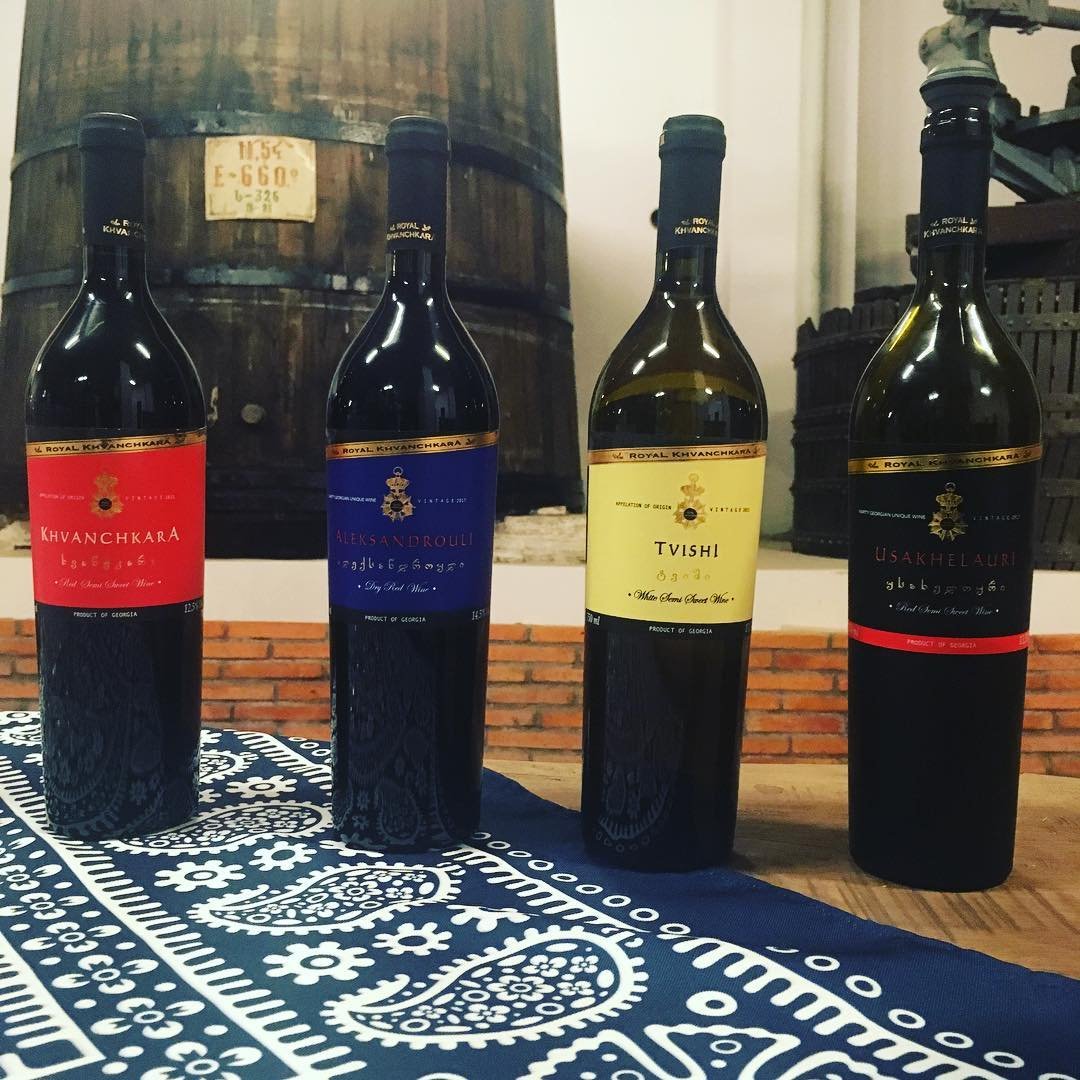
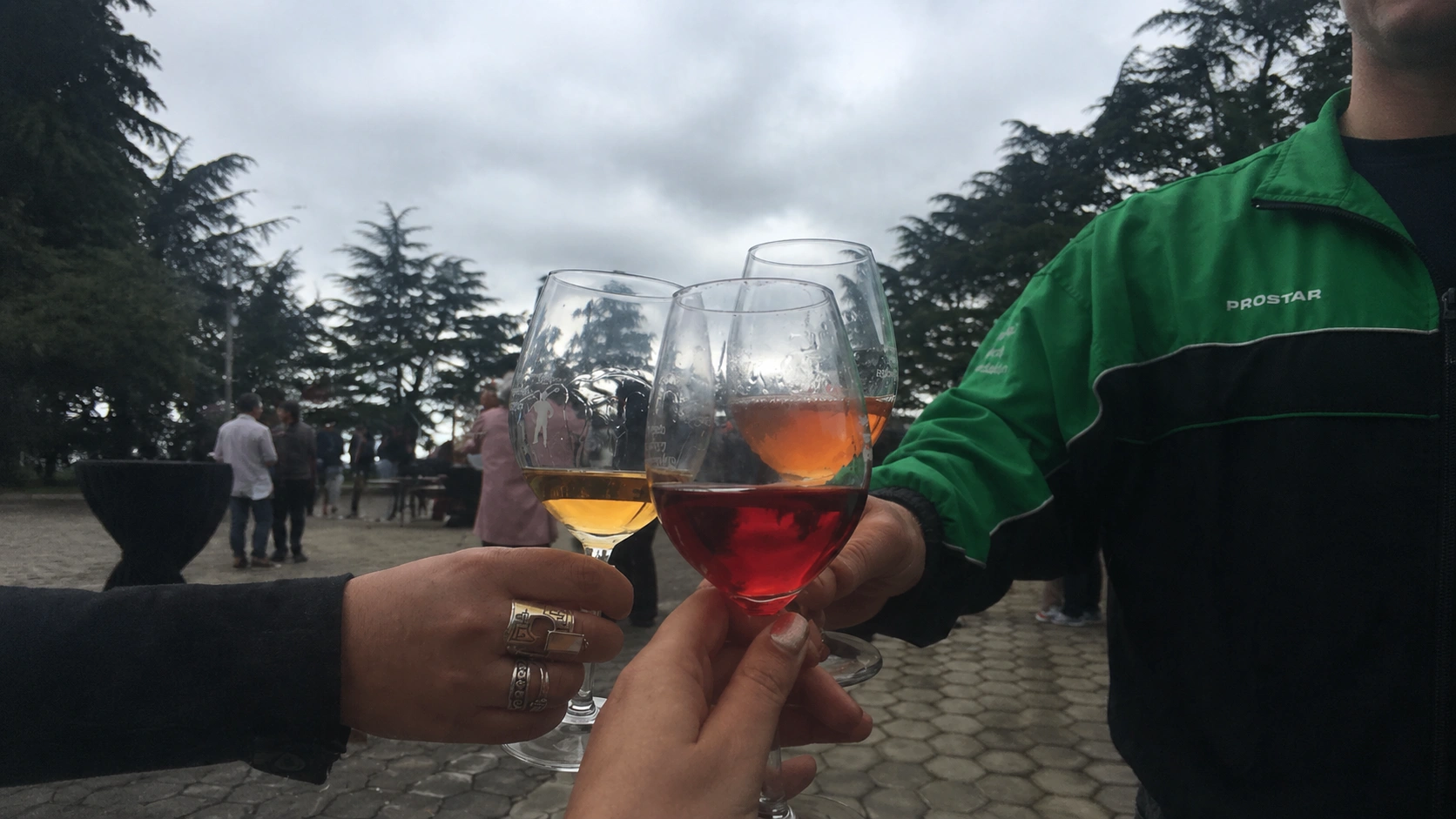
Classically it is made semi-sweet, dark ruby, with a berry character that fights the chilli in Megrelian food to a useful draw. Dry versions are now widely made and are the better match for kupati. It carries a protected designation of origin, so the label tells you the truth about where it came from.
PRACTICAL ANSWERS
Frequently Asked Questions
How many days do I need in Samegrelo?
Two nights covers Zugdidi, Martvili Canyon and Nokalakevi at a reasonable pace. Three to four adds the coast, Enguri Dam and the quieter canyons. A Tobavarchkhili trek needs a week on its own.
Can I visit Samegrelo as a day trip?
From Kutaisi, yes — Martvili Canyon and Nokalakevi work comfortably in one day. From Tbilisi it is a very long day for one canyon. Batumi day trips to Martvili exist but involve five hours of driving.
Where should I base myself?
Zugdidi for the palace, the coast, Enguri and onward transport to Svaneti. Martvili for the canyons and monasteries. If you only get one base, make it Zugdidi.
Is Samegrelo safe?
Yes. Ordinary crime is rare and Georgian hospitality does the rest. The real cautions are road surfaces, river levels after rain, and the administrative boundary with Abkhazia near Anaklia and along the Enguri, which must not be crossed.
How much does Martvili Canyon cost?
20 GEL entry for foreign adults, 5.50 GEL for children aged 6–18, free under 6. The boat ride is an extra 20 GEL per person and requires a minimum height of one metre.
Do I need a car?
Marshrutkas link the towns, but the canyons, waterfalls and churches sit off the main roads with sparse service. A hired car, or a driver for the day at roughly 80–150 GEL, transforms what you can see.
What is Megrelian and should I learn any?
It is a Kartvelian language related to Georgian but not intelligible to Georgian speakers, and it has no written standard. “Gagimarjos” works as a toast in both. Everything else you say in Georgian, English or Russian.
Is Samegrelo good in winter?
For museums, monasteries and empty canyons, yes — it rarely freezes on the plain. For mountains, no. The Egrisi passes are closed and the high routes are inaccessible from October to July.
Can you help me plan a Samegrelo trip?
We have been running tours across western Georgia since 2011, including combined Samegrelo and Svaneti itineraries that use the region as more than a transit stop. Get in touch and we will build something around your dates and interests.
THE LAND THE GREEKS CALLED COLCHIS
Explore Samegrelo With Highlander Travel
Canyons, a Byzantine-frescoed cathedral, the Colchis wetlands and a princely palace — combined with Svaneti or travelled slowly on their own, with transport, guides and timings handled.


