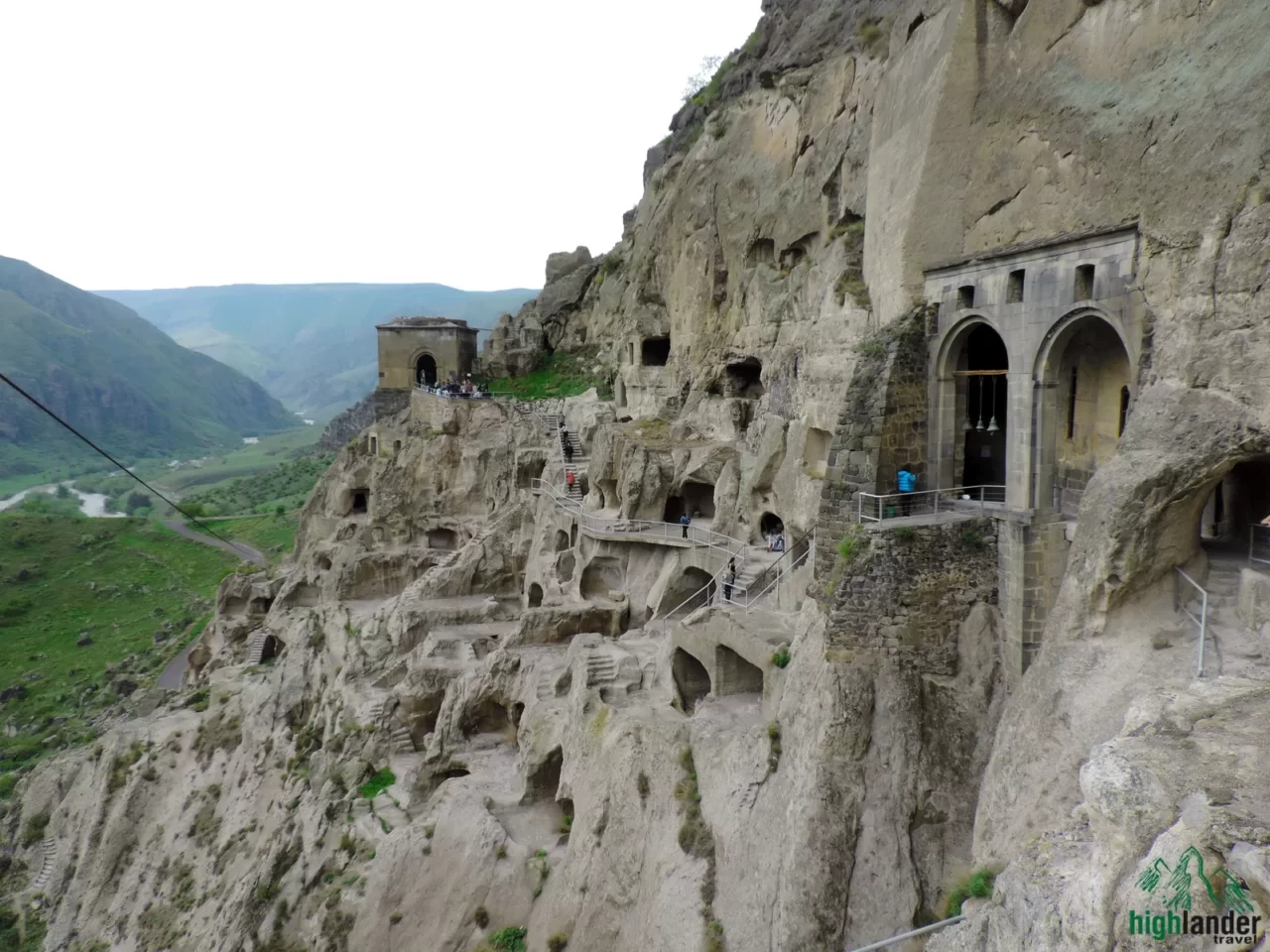
For a hundred years nobody could see Vardzia. The monks who built it in the 1180s cut the whole thing into the cliff — thirteen storeys of chambers, churches, cellars, stairwells and water pipes, with only narrow openings facing the valley. From the far bank of the Mtkvari it looked like a rock face. That was the point: this was a monastery on a border, and a border with Persia and later the Ottomans was not a place to advertise where two thousand monks and soldiers slept.
Then in 1283 the mountain shook. A landslide took the outer wall off and left the interior open to the air like a cross-section drawing. What you climb through today is a building turned inside out by an earthquake.
Vardzia sits 250 kilometres south of Tbilisi, near the Turkish border. That is the whole reason this tour takes two days. The round trip is over five hundred kilometres of mountain road, and the operators who sell it as a day trip are asking you to spend ten hours in a car in exchange for about ninety minutes at the site. We cap the driving at 350 kilometres a day and put you in a guesthouse near the caves overnight, which means you walk into Vardzia in the morning with a whole day still in you.
The road there is not filler. You stop at Borjomi to drink the mineral water out of the spring it is bottled from, at the Rabati fortress in Akhaltsikhe where Georgian castle walls and an Ottoman mosque stand in the same courtyard, at Sapara monastery in the forest, and at Khertvisi, which has been guarding the junction of two rivers since the tenth century. Every one of them is there because of the same geography: this valley was the road to Byzantium, and whoever held these passes held the way through.
Who this is for: people who like historic places and want more than a photograph of one; anyone who has already done a rushed day trip in Georgia and did not enjoy it; photographers, because the light in the cave churches and on the Javakheti lakes rewards patience.
Who it is not for: anyone who cannot manage a lot of stone stairs — Vardzia is climbing, not strolling; travellers who want a hotel with a spa at the end of the day; and first-time visitors with only three or four days in the country, who should do Kakheti and Kazbegi first and save this for next time.
What you’ll see
Tour highlights
- Vardzia itself — thirteen storeys of chambers, churches and tunnels cut into a volcanic cliff in the 1180s, with two or three unhurried hours to climb through them rather than the hour a day trip allows.
- The frescoes in the Church of the Dormition — including the portrait of Tamar painted while she was alive, which makes it one of very few contemporary likenesses of a medieval Georgian monarch.
- Rabati at Akhaltsikhe — a fortress rebuilt into a small walled town, where a Georgian citadel, an Ottoman mosque and a synagogue sit inside one set of walls.
- Sapara monastery — tenth century, up a forest road, with stone carving that most visitors to this region never see because it is not on the day-trip route.
- Khertvisi fortress — perched where the Mtkvari and Paravani rivers meet, one of the oldest fortifications still standing in Georgia.
- Borjomi park — drink the water from the spring, in the park it made famous, on the way south.
- The Javakheti plateau on the way home — volcanic highland at around 2,000 metres, with Lake Paravani and Lake Sagamo and the migratory birds that come up from Africa to breed on them.
- A night near the caves — the single thing that separates this from every one-day Vardzia tour sold in Tbilisi.
Step by step
Tour itinerary
Day 1 · Tbilisi to Vardzia, the long way round
Morning — south through Shida Kartli, and a drink at Borjomi
We collect you in Tbilisi and head south-west. The first stop is Borjomi, where the park was built around the mineral springs in the nineteenth century and the water still comes out of the ground warm, salty and faintly metallic. Drink it from the spring rather than a bottle at least once; it tastes nothing like the bottled version and the difference is the whole story of the place.
Midday — Rabati, and lunch in Akhaltsikhe
Akhaltsikhe means “new castle”, and the castle in question is Rabati: a fortress rebuilt in 2012 into something closer to a small walled town, with a Georgian citadel, an Ottoman mosque, a church and a synagogue inside the same set of walls. Purists grumble about how thoroughly it was restored. What is not in dispute is the geography — this was the regional capital, on the road between central Georgia and Byzantium, and standing on the ramparts you can see exactly why somebody put a fortress here. Lunch in town afterwards.
Afternoon — Sapara in the forest
A narrow road climbs out of Akhaltsikhe into the trees and ends at Sapara, founded in the tenth century, its main church built in the fourteenth. It is quiet in a way Rabati is not, and the carving on the stonework is some of the best in southern Georgia. Most visitors to this region drive past the turning without knowing it is there.
Late afternoon — the fortresses along the Mtkvari
From here the road follows the upper Mtkvari valley towards Vardzia and the fortresses start appearing on the ridgelines. The Saro towers first, then Khertvisi, which sits on a spur exactly where the Mtkvari and the Paravani meet and has been there in some form since the tenth century. These were working buildings, not ornaments — the pass behind them was the route to Anatolia and somebody was always coming up it.
Evening — arrival
The valley narrows, turns, and Vardzia is suddenly on the cliff above you, which is a better first sight of it in the late light than at midday. You check into your guesthouse a few minutes away and eat dinner there — Georgian home cooking, and more of it than you expect.
Day 2 · Inside the caves, then the high road home
Morning — Vardzia
Breakfast at the guesthouse, then straight up to the site while it is still cool and quiet. You climb between levels on stone stairs worn smooth by eight hundred years of feet, through monks’ cells and storerooms and refectories and out into the Church of the Dormition, where the frescoes include a portrait of Tamar painted during her own lifetime — one of very few images of a medieval Georgian ruler done from life. The water system alone is worth a slow look: clay pipes running through solid rock, still following the gradient they were cut to.
Two to three hours here, unhurried. That is the tour.
Midday — Tsunda, and lunch
Before leaving the valley we stop at Tsunda church, small and much older-feeling than its neighbour, set where you get a different angle back across the gorge. Lunch after — packed or at a local place, depending on how the morning has run.
Afternoon — the Javakheti plateau
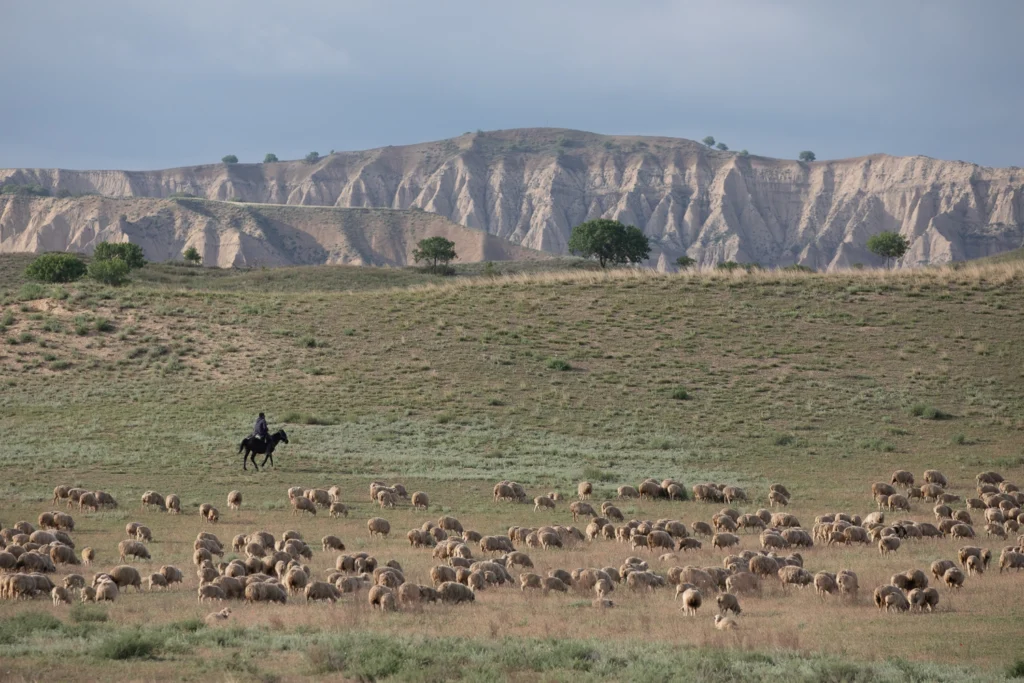
The road home climbs onto volcanic highland at close to 2,000 metres, and the landscape changes completely: no trees, enormous sky, grass and stone to the horizon. Lake Paravani and Lake Sagamo lie up here, shallow and still on a calm day, and the wetlands around them are a breeding ground for birds that fly up from Africa. We stop at viewpoints when the light is worth it.
Evening — Tbilisi
Down off the plateau and back into the city, dropped where we collected you, in the evening. Under 350 kilometres on each of the two days, which is the point of doing it this way.
Starting from
€-1
per person
Locally operated since 2011
We reply within 24 hours
What your price covers
What’s included
Included
- Private vehicle with an experienced driver, including all fuel and vehicle costs
- Pick-up and drop-off at your accommodation in Tbilisi — or Kutaisi, at the same price
- One night’s accommodation in a guesthouse or small hotel near Vardzia
- Meals: one breakfast, two lunches, one dinner
- Drinking water throughout both days
- All entrance fees — Vardzia, Rabati, Sapara and the fortresses
- Experienced English-speaking guide
- A maximum of 350 km driving on either day
Not included
- Alcoholic drinks
- Snacks and personal expenses
- Travel and medical insurance — strongly recommended
- Tips for the guide and driver, welcome but never expected
- Any meal not listed under “Includes”
- Optional activities not listed in the itinerary
Photographs
Gallery
Where you’ll go
Map & route
Practical details
Good to know before you go
How hard is it, really
The driving is comfortable and the walking is not difficult — except at Vardzia, where it is. You climb between thirteen levels on original stone stairs, worn round at the edges, sometimes narrow, occasionally in the dark. There are no handrails in most of it. Most people of most ages manage it perfectly well and the two-day pace helps enormously, but if you have significant knee, hip or balance problems, tell us before you book rather than on the morning. Parts of the complex can be skipped without missing the point; the whole tour cannot be done sitting down.
What to bring
- Proper shoes, with grip. This is the one item that matters. Trainers with a worn sole are the wrong choice on eight-hundred-year-old stone; walking shoes or light boots are the right one.
- Layers. The valley floor and the Javakheti plateau are 1,000 metres apart in altitude and can be fifteen degrees apart in temperature on the same afternoon. A windproof outer layer earns its space.
- Sun protection. The plateau has no shade at all and the cave terraces have very little. Hat, cream, sunglasses.
- A camera you can carry hands-free. You will want both hands on some of those stairs. A strap or a small bag beats holding a phone.
- A refillable bottle. We provide water; bring something to put it in.
- A light rain layer. Mountain weather changes fast in both directions.
When to go
| Season | What it’s like |
|---|---|
| April – May | Wildflowers on the plateau, mild days, clean light. The best photography of the year. |
| June – September | Long days and everything open. Hot in the valleys at midday — start early and the caves stay cool. |
| October – November | Autumn colour, sharp air, the clearest visibility. Arguably the best month is October. |
| December – March | On request only. The plateau road takes snow and some sites reduce their opening hours. Beautiful and empty if conditions allow, but we confirm it a few days ahead, not months. |
Where you sleep
A family guesthouse or small hotel near Vardzia: clean, warm, hot water, private or shared bathroom, and home cooking that is usually the food people remember from the trip. It is not a hotel with a lobby, and the village it is in has a few hundred people in it.
Food and dietary requirements
Georgian cooking has a deep vegetarian repertoire — beans, walnuts, aubergine, cheese, herbs — so meat-free is easy here and nobody will treat it as a problem. Vegan takes a little planning and is entirely possible with notice. Allergies and religious requirements: tell us when you book, so we can talk to the guesthouse before you arrive rather than in front of you.
Starting from Kutaisi
The same tour runs from Kutaisi at the same price. The itinerary is nearly identical; the Javakheti lakes are replaced by the western return route. In summer, departures from Kutaisi can include Abastumani and the Zekari road via Sairme instead — ask when you book.
Group size, children and price
This is a private tour: your group only. The per-person price falls as the group grows, and the booking form shows you the exact figure as soon as you enter your numbers. Children travel at a reduced rate and count towards the group size that sets the price band — ask us for the current child rate and age range when you enquire.
From our travellers
Reviews
Before you book
Frequently asked questions
How far is Vardzia from Tbilisi?
About 250 kilometres, which is four to five hours of mountain driving in each direction. That distance is the reason this is a two-day tour.
Why don’t you run a one-day Vardzia tour?
Because the round trip is over five hundred kilometres. A day trip means ten hours in a vehicle in exchange for roughly ninety minutes at the site, and you arrive at the one thing you came for already worn out. We cap driving at 350 kilometres a day and stay overnight near the caves instead. It costs you a day and it is the difference between seeing Vardzia and just reaching it.
How long do we actually get at Vardzia?
Two to three hours, in the morning, without a return drive hanging over anyone. That is enough to climb through the levels properly, spend real time in the Church of the Dormition with the frescoes, and sit down somewhere with a view before you leave.
How difficult is the climbing?
Moderate. The stairs inside Vardzia are original stone, worn smooth, narrow in places and without handrails for most of the route. Most visitors of most ages manage it comfortably. If you have knee, hip or balance problems, tell us before booking — parts can be skipped, but the site cannot be seen from the car park.
Can I start from Kutaisi instead of Tbilisi?
Yes, at the same price. The itinerary is nearly identical, with the Javakheti lakes replaced by the western return route. Summer departures from Kutaisi can include Abastumani and the Zekari road via Sairme instead.
Is it suitable for children?
Children who can handle stairs and a fair amount of walking enjoy Vardzia enormously — it is a cave city, which is a strong start. Children travel at a reduced rate and count towards the group size that sets the price. There is a lot of car time on both days, so bring something for the road.
When can the tour run?
April to November as standard. October and May are the two best months. December to March we run on request only, because the plateau road takes snow and some sites shorten their hours — we confirm winter dates a few days ahead rather than months.
What is the accommodation like?
A family-run guesthouse or small hotel near Vardzia. Clean, warm, hot water, private or shared bathroom, and very good home cooking. It is not a luxury hotel and it does not pretend to be — it is the kind of place that gives this part of the trip its character.
Can you cater for vegetarians or vegans?
Vegetarian, easily — a large part of the Georgian repertoire happens to be meat-free. Vegan with advance notice. Allergies and religious requirements too, as long as you tell us when you book so the guesthouse can plan for it.
Can I take photographs inside Vardzia?
Yes, throughout the complex. Some churches restrict flash to protect the frescoes, which is worth respecting for its own sake — the pigments are eight hundred years old. Your guide will tell you where.
What language does the guide speak?
English as standard, and we confirm the language when you book. Other languages can usually be arranged with notice.
Ready when you are
Tell us your dates and how many of you are travelling. We’ll come back within 24 hours with availability, a confirmed price, and your guide’s name.