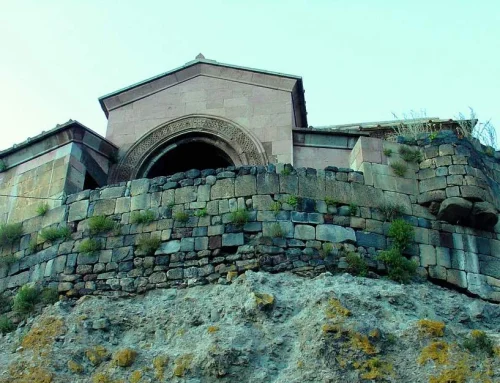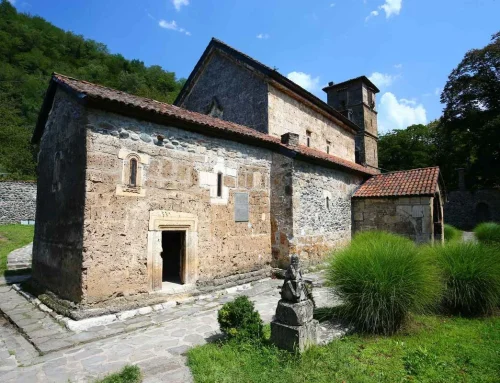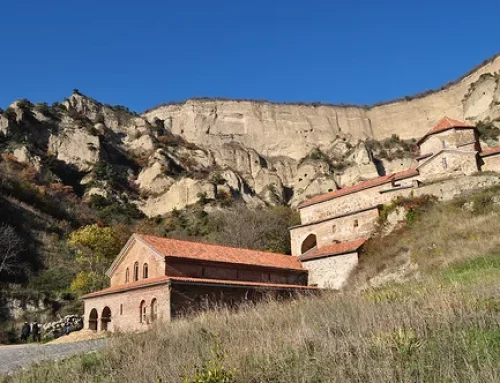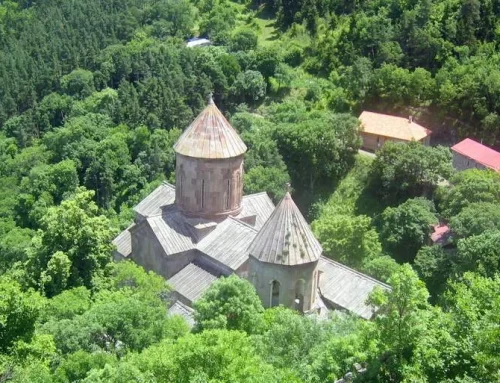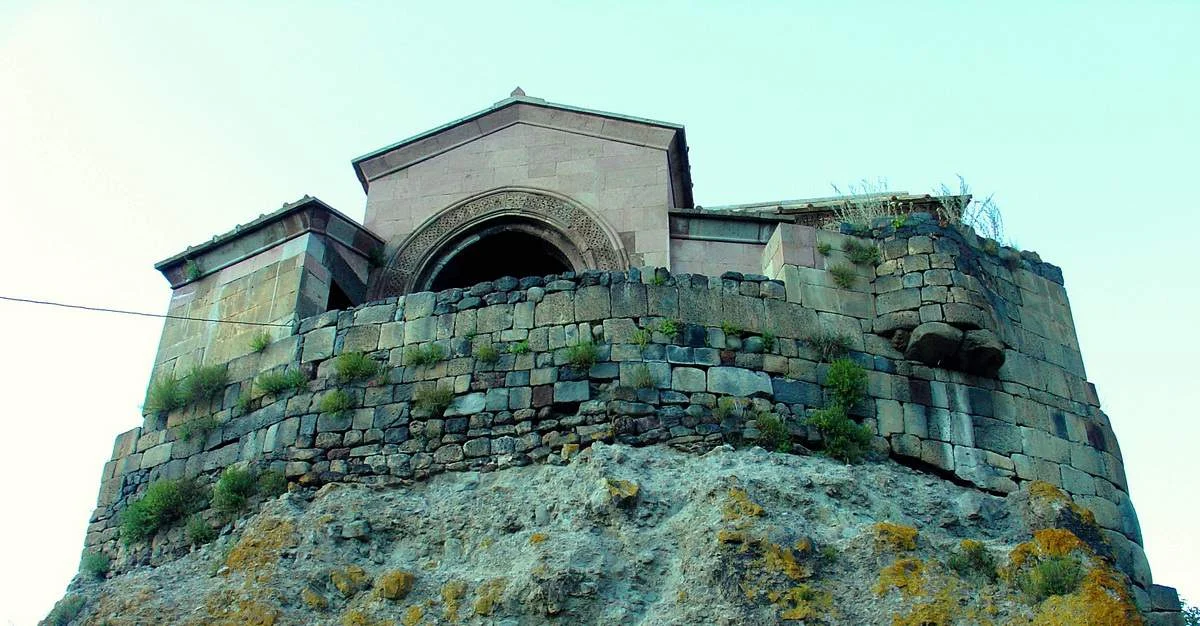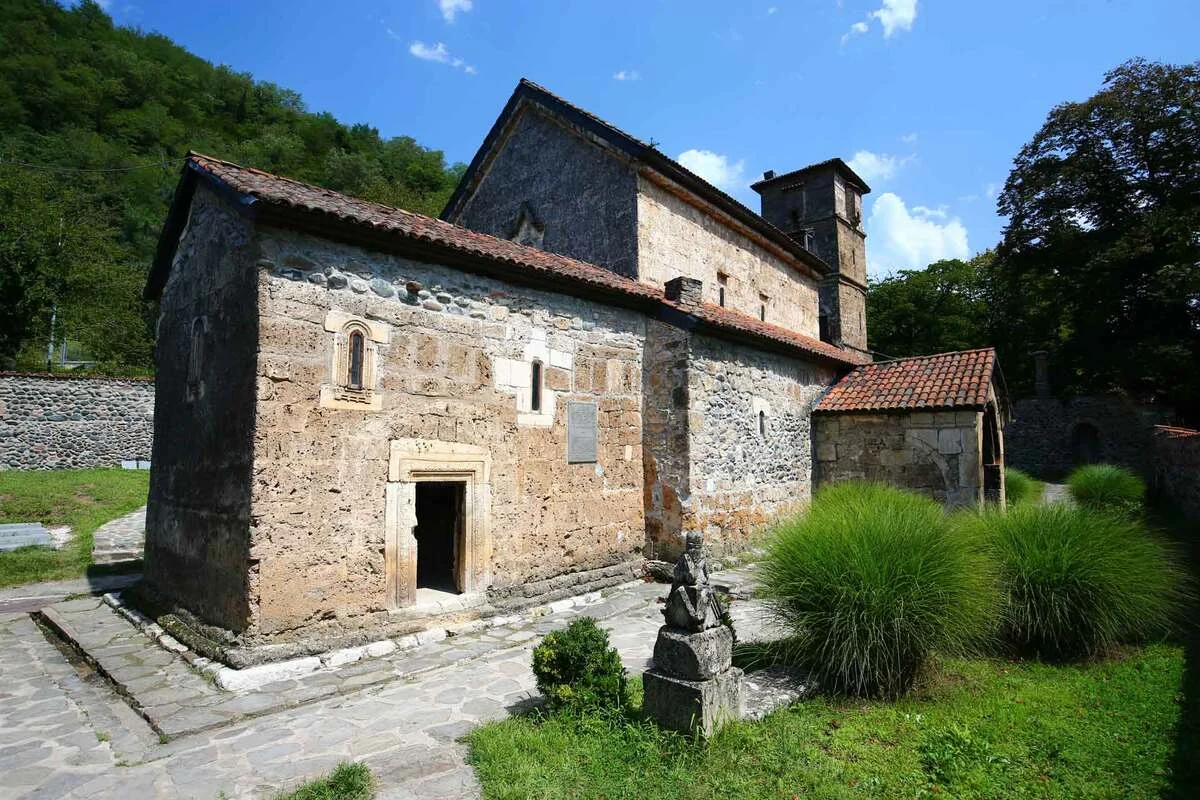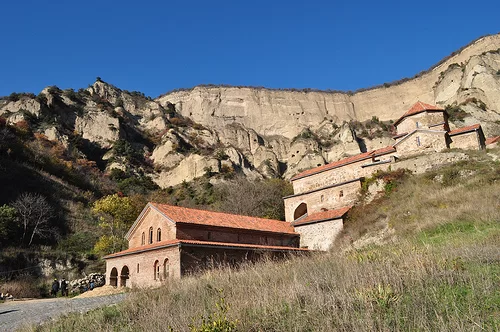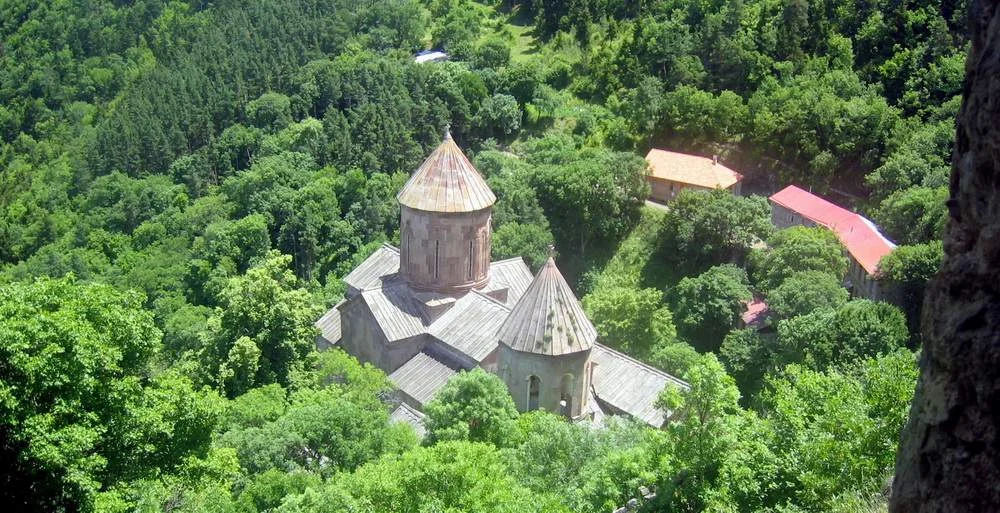
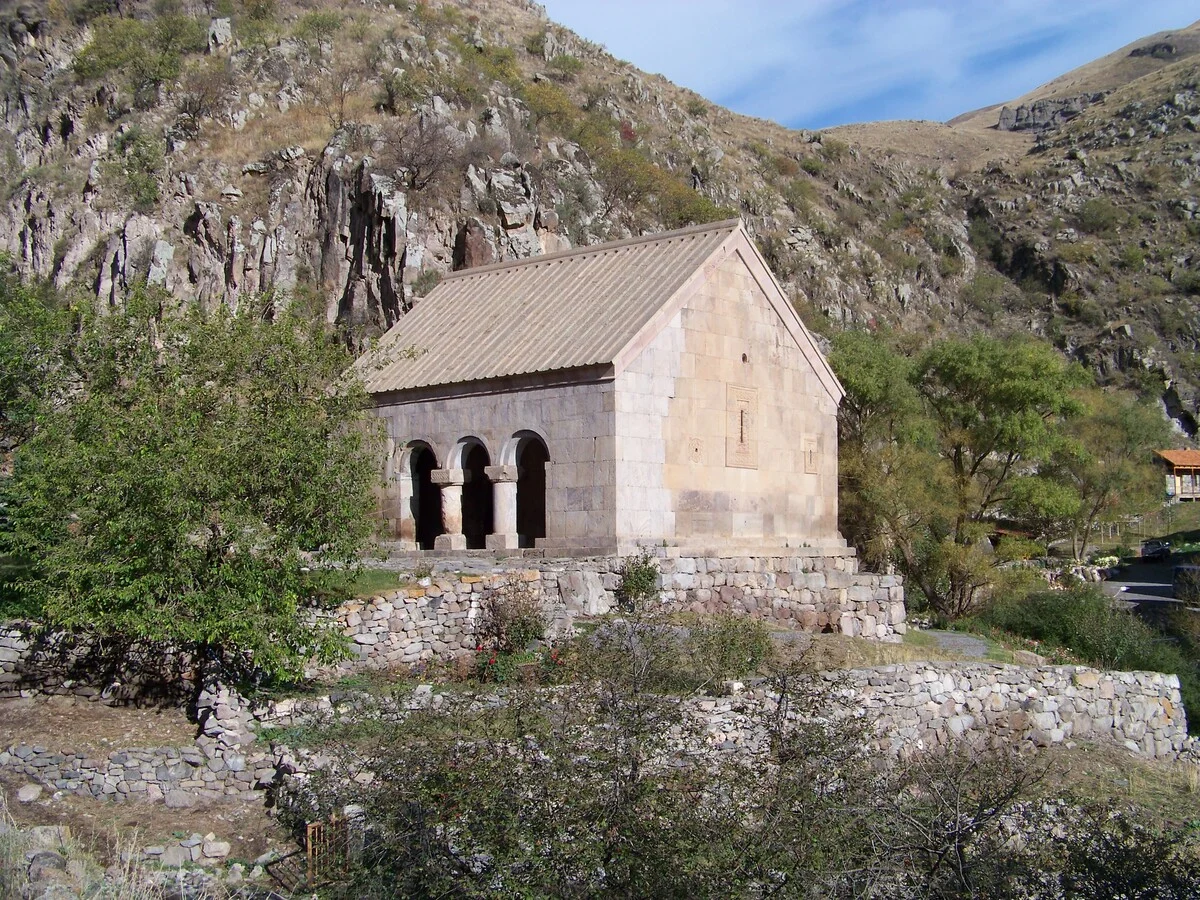
A few kilometres from the famous Vardzia cave monastery, in a quiet side valley of Samtskhe-Javakheti, stands a much smaller and older religious site: Upper Vardzia Monastery, also known as Zeda Vardzia.
While Vardzia itself is a vast 12th-century rock-cut complex associated with King Giorgi III and Queen Tamar, Upper Vardzia preserves an earlier phase of Georgian religious architecture.
Its main monument is the Church of the Dormition of the Virgin, a masonry church dated broadly to the 9th–11th centuries. The dating is supported by an Asomtavruli inscription at the entrance.
Today the site is again an active convent, making it both a historical monument and a living religious community.
Where Is Upper Vardzia?
Upper Vardzia lies in Aspindza Municipality, only a short distance from the main Vardzia complex.
Georgia Travel places the village and convent approximately 3 km from Vardzia.
The monastery sits higher in the surrounding landscape, in a much quieter setting than the main cave city.
This makes it particularly appealing for travellers who want to explore the Vardzia area beyond the famous rock-cut monument.
Upper Vardzia Is Older Than the Cave Monastery
One of the most important reasons to visit Upper Vardzia is its chronology.
The famous Vardzia cave complex was developed mainly in the 12th century, whereas the surviving church at Upper Vardzia belongs to an earlier period, broadly between the 9th and 11th centuries.
That difference helps visitors understand that the religious landscape of the upper Mtkvari Valley did not begin with Queen Tamar.
Long before the construction of the great cave monastery, Christian communities were already active in this part of southern Georgia.
The Church of the Dormition
The principal building at Upper Vardzia is the Church of the Dormition of the Virgin.
Unlike the excavated chambers of Vardzia, this is a conventional masonry church built from carefully dressed stone.
Its form is relatively unusual.
The interior is divided into two aisles, with the southern aisle functioning as the principal space and the northern aisle considerably narrower and darker.
A southern gallery or porch with open arches gives the church an appearance that can initially suggest a more complex three-part structure.
The result is a building that is modest in scale but architecturally distinctive.
The Southern Arcade
One of the most attractive parts of the church is the southern side.
An open arcade runs along the façade, with carved architectural details that give the otherwise restrained building a more elegant appearance.
Georgia Travel specifically notes that the columns of the southern porch are decorated with carving.
The interplay of arches, columns and stone surfaces creates the strongest visual element of the exterior.
The Entrance Decoration
The southern entrance is one of the most refined details of Upper Vardzia.
Its carved stone frame includes ornamental work and a cross motif above the doorway.
This decoration is much more delicate than the monumental effect of the building as a whole.
For travellers interested in medieval Georgian stone carving, these smaller elements are worth examining closely.
The Asomtavruli Inscription
The inscription at the entrance is historically important because it helps establish the church’s medieval date.
It is written in Asomtavruli, the monumental form of Georgian script widely used in ecclesiastical inscriptions.
The older article associated the church with a powerful feudal lord named Liparit Eristavt-Eristavi. That attribution should be presented cautiously unless the exact inscription is independently confirmed.
What can be stated securely from current official Georgian tourism material is that the entrance inscription supports a 9th–11th-century date for the church.
Surviving Wall Painting
The interior was once considerably richer than it appears today.
Traces of medieval wall painting survive, but only small portions remain.
Georgia Travel notes that the church was once extensively decorated and that surviving fragments provide evidence of this earlier painted interior.
Because so little survives, precise dating of the original fresco cycle is difficult.
Visitors should therefore approach the site primarily for its architecture, historical position and setting rather than expecting a fresco ensemble comparable with Vardzia or Sapara.
Hidden Spaces Above the Vaults
One of the more interesting architectural features is the construction above the side spaces.
The double-pitched roof conceals additional enclosed areas above the arches.
These upper spaces contribute to the unusual massing of the church and distinguish it from a simple single-nave hall church.
They also demonstrate the sophisticated use of internal volumes by medieval Georgian builders.
Restoration
Upper Vardzia suffered damage over the centuries.
The southern porch was among the elements that deteriorated substantially.
The building underwent major restoration during the Soviet period, and Georgia Travel now describes the church as fully restored.
The restoration preserved the overall medieval architectural form while making the church usable again.
An Active Convent
Upper Vardzia is not merely a historic church.
Georgia Travel records that an active convent has operated here since 1998.
Visitors should therefore treat the site as a functioning religious community.
Dress modestly, keep voices low and avoid intrusive photography around nuns or during services.
This active religious character is another point of contrast with the much more intensively visited main Vardzia complex.
Upper Vardzia and Vardzia
The two sites are best understood together.
Vardzia represents medieval Georgia at royal and monumental scale: an immense rock-cut monastery developed mainly in the 12th century, with churches, cells, tunnels, storerooms and an elaborate water system.
Upper Vardzia is smaller, quieter and earlier.
Visiting both reveals two distinct phases in the religious history of the same valley.
Upper Vardzia shows that the area had ecclesiastical importance before the great cave monastery was created.
Explore the Wider Vardzia Region
Upper Vardzia belongs to one of the richest historical landscapes in Samtskhe-Javakheti.
Nearby sites include:
- Vardzia Cave Monastery
- Tsunda Church
- Vanis Kvabebi
- Tmogvi Fortress
- Khertvisi Fortress
- Saro
- the Javakheti Plateau
Together, these places show that Vardzia was never an isolated monument.
The entire upper Mtkvari region was densely occupied by monasteries, fortresses, noble estates and settlements.
Visit Upper Vardzia on a South Georgia Itinerary
Upper Vardzia is not currently listed as a standard stop on the published 2-Day Vardzia Tour from Tbilisi.
That tour currently includes Vardzia, Tsunda, Sapara, Khertvisi, Borjomi and the Javakheti Plateau.
However, Upper Vardzia lies close enough to the main cave complex that it can be discussed as a possible addition for travellers particularly interested in medieval churches and quieter historical sites.
For a deeper exploration of southern Georgia, the 4-Day Mystic South Georgia Tour is even more relevant.
Its current route already includes Vardzia, Vanis Kvabebi, Upper Tmogvi, Khertvisi, Saro and the Javakheti Plateau.
Upper Vardzia is therefore geographically well suited to a customized version of this itinerary.
Upper Vardzia and Tsunda
Upper Vardzia also combines naturally with Tsunda Church.
The two sites offer an interesting architectural comparison.
Upper Vardzia represents an earlier medieval religious foundation with an unusual two-aisled arrangement.
Tsunda, built later during Georgia’s Golden Age, is a smaller aristocratic hall church closely connected with the noble culture of the Vardzia–Tmogvi area.
Visiting both adds depth to a Vardzia itinerary without requiring major additional driving.
When to Visit
Spring and autumn are particularly attractive for exploring Upper Vardzia.
The valley is greener in spring, while autumn brings softer light and comfortable temperatures.
Summer access is straightforward but afternoons can become hot.
Winter visits are possible depending on road and weather conditions, although snow and ice can affect travel throughout Samtskhe-Javakheti.
Practical Information
Upper Vardzia is a quieter site with limited tourist infrastructure.
Allow around 30–45 minutes for the church and surroundings.
Because it is an active convent:
- dress modestly;
- avoid loud conversation;
- ask before photographing inside;
- do not interrupt religious services.
It works best as an additional stop rather than as a standalone day trip.
Why Visit Upper Vardzia?
Upper Vardzia is valuable precisely because it is different from the famous cave monastery nearby.
There are no vast tunnels, crowds or monumental cliff façades.
Instead, visitors find an older medieval church, delicate stone carving, fragments of wall painting and an active convent in a quiet side valley.
Its greatest importance lies in chronology.
Upper Vardzia demonstrates that the religious history of this area began before the construction of Queen Tamar’s famous cave monastery.
For travellers who want to understand the wider historical landscape rather than simply tick Vardzia off a sightseeing list, it is a worthwhile addition.
Frequently Asked Questions
Where is Upper Vardzia Monastery?
Upper Vardzia is located in Aspindza Municipality in Samtskhe-Javakheti, around 3 km from the main Vardzia complex.
Is Upper Vardzia older than Vardzia?
Yes. The surviving Dormition Church is dated broadly to the 9th–11th centuries, while the main Vardzia cave complex developed primarily in the 12th century.
What is Upper Vardzia also called?
It is commonly called Zeda Vardzia, meaning Upper Vardzia.
What is the main church?
The principal monument is the Church of the Dormition of the Virgin.
Are there frescoes?
Yes, but only limited fragments of the earlier wall painting survive today.
Is Upper Vardzia an active monastery?
Yes. An active convent has operated at the site since 1998.
Is Upper Vardzia included in the standard Vardzia tour?
Not currently on the published 2-Day Vardzia Tour. It is better presented as a possible addition to a customized itinerary.
What should I combine with Upper Vardzia?
The most natural nearby sites are Vardzia, Tsunda, Vanis Kvabebi, Tmogvi and Khertvisi.